NOW that the Board of Investments (BOI) and the Bureau of Internal Revenue (BIR) have admitted that they were giving tax holidays to every Tom, Dick and Harry without asking why, it’s high time for Congress to take over and launch a thorough investigation on the matter.
Right now, Congress is trying to reform the country’s fiscal incentive system through the “fiscal rationalization” bill and it would help if they first get to the bottom of this issue. Congress should do it not just “in aid of legislation” but in pursuit of economic equity and social justice!
The other day, Trade Undersecretary Elmer Hernandez told our reporter Max de Leon that some companies are enjoying income tax holiday despite the fact that they are not eligible to get these perks. Each year, the country loses about P300 billion in forgone revenues—and part of this forgone amount goes to those who don’t deserve them because, as Hernandez admitted, many of those who availed themselves of the fiscal perks were not entitled to them.
Hernandez said the government lost billions because the BIR just allowed income tax holiday claims in their income tax returns even without proof from the BOI that the claimants were really eligible for the perks. He seems to be telling us that it’s just a simple, honest mistake, or one caused by sheer inability of state agencies to get their act together or streamline their systems owing to the great burden of their work.
We don’t think so. We believe a large part of such neglect grows out of corruption that has been plaguing the country’s fiscal-incentive system since the last several decades.
We don’t think bureaucrats from the BOI and the BIR are people who are naïve enough to allow these shenanigans to get through under their noses unless some people deep within these bureaucracies are benefiting financially from it.
The questions right now are the following: What are those companies that stole from the country’s coffers? Who in the BIR approved their ITH claims? How much money did the country lose to what companies since the President Aquino Executive Order 226? And why is it that BOI doesn’t seem to have any idea about how the country’s incentives system is being implemented? How about the Peza’s incentive system? These are questions that boggle our mind.
This blatant abuse of the fiscal incentives system is almost criminal. For years, the country, nay the Filipino people, have been suffering from poverty and lack of economic opportunities for the simple reason that the State could not provide good economic and social infrastructure. Bureaucrats have been telling us ordinary mortals that the government needs to collect more taxes “to finance development” and we were foolish enough to agree to a higher VAT rate on all the things we buy with our slave wages. Little did we know that while these bureaucrats were taking away food from the mouths of our children, they gave away hundreds of billions of pesos worth of income tax holidays to favored friends and clients, including to ones not entitled to the fiscal perks in the first place.
God knows how much money bureaucrats from the BIR and the BOI and other “investments promotions agencies” are really giving away to favored companies. For all we know, they have been giving away the Filipino nation’s birthright, probably the main reason why we can’t seem to achieve economic takeoff despite a favorable external economic environment.
In the last 20 years, BOI, the Philippine Economic Zone Authority and several other “investments promotion agencies” have been giving away all sorts of perks—income tax holiday; duty-free importation of machines and equipment; exemption on duties and taxes on imported spare parts; exemption from wharfage dues and export tax, duty, imposts and fees; tax exemption on breeding stocks and genetic materials; tax credits; and additional deductions from taxable income—and we can’t seem to account for their impact on the Philippine economy and our future as a nation.
Agencies like the National Economic and Development Authority, the Department of Finance, and the Department of Trade and Industry cannot account for the real contribution of these perks to economic development because they may have been designed as a vehicle for rent-seeking behavior in the bureaucracy. Amid this flurry of perks are a tangle of almost 200 other laws and executive orders giving privileges to companies to claim more fiscal perks from the country’s coffers for several other economic activities ranging from the production of steels and ships and jewelries. This confusing snarls of laws and regulations and the apparent lack of transparency with which these agencies implement them suggest that abuses like double-dipping (claiming perks for the same projects from several laws and agencies) and the brazen act of collecting perks for investment projects that were not even registered with the BOI are prevalent.
Right now, the DTI does not want to release detailed information about the issue because “they are still completing their findings.” Congress should not wait for that report before acting on behalf of the Filipino people.
Monday, October 30, 2006


Imports figures say economy is on track
.jpg) Imports rose more than ten percent in January-August this year, allaying fears of a possible slowdown late this year. It’s encouraging to note that purchases of capital equipment also rose significantly at more than 8 percent. It means our business people are buying machines and equipment for their factories and offices, an indicator of business confidence. But is it enough to reverse the decline in capital formation? That's the big question that could only be answered with the release of national income accounts in the third quarter.
Imports rose more than ten percent in January-August this year, allaying fears of a possible slowdown late this year. It’s encouraging to note that purchases of capital equipment also rose significantly at more than 8 percent. It means our business people are buying machines and equipment for their factories and offices, an indicator of business confidence. But is it enough to reverse the decline in capital formation? That's the big question that could only be answered with the release of national income accounts in the third quarter.Notable increases in capital imports could be noticed particularly in telecommunications equipment and electrical machines, as well as aircraft, ships and boats. This means the telecom boom in this country is continuing. The drive towards the 3G is one possible factor for this trend.
Friday, October 27, 2006
It's time to move on
Now that the Supreme Court has rejected Sigaw ng Bayan’s petition for Charter change through the “people’s initiative,” let’s bury that effort deep into Hades and move on with our lives.
If there’s one major political issue that’s dividing the country and has prevented the government from focusing its energies on the Philippine economy, that’s the Cha-cha. Let’s now consign it to the dustbin of history. Let’s work together as a nation to focus on the economy where we could really make a difference in the lives of ordinary people.
Actually, the Filipino people have moved on a long time ago and focused on what really matters most—their means of living. In the 10 quarters the Philippine economy has been growing within the 5-percent to 6-percent growth rate band despite all the handicaps of having to put up with corrupt leaders and perpetually squabbling politicians. And it’s quite a broad-based effort as the farms, factories and services all contributed significantly.
Our entrepreneurs, despite all the odds, moved heaven and earth to set up as well as attract investors in call centers, shared services, software developers and electronics if only to provide job opportunities and hopes to young college graduates.
Sick and tired of negativism and continuing tales of corruption in high places, many of our countrymen, many of them women, have left the country to slave it out as domestic helpers, nurses, engineers and service workers so they could send back dollars to their families and save the country from tearing apart. The government, the State and its leaders, have failed them but those OFWs can’t afford to fail their families so they just closed their eyes and out they went to endure loneliness and hard work in foreign shores.
Now, the entrepreneurs’, the farmers’ and OFWs’ money are lifting the economy out of its boom-bust cycles, creating demand for goods and services, giving life and more profits to factories, banks, hotels and restaurants, and shopping malls. Certainly, these gains are not enough to create a million jobs and soak up joblessness, but the people have done a lot of their own to kick-start an economic revolution that may yet lift the economy into a higher growth path if only the country’s political leaders would cooperate.
Yes, in the last 10 quarters, the economy—and we call it a people’s economy because it has been moving steadfastly on autopilot —grew amid declining capital expenditures from the government. Yes, the people—the entrepreneurs, including foreign investors; the working people in offices, farms and factories; and OFWs have moved on and tried hard to do business and create jobs while bureaucrats and politicians holding the levers of power are preoccupied with nothing but their day-to-day political survival.
And yes, the people sacrificed a lot by agreeing to a higher value-added tax if only the country’s finances could rise up beyond the shortsightedness of their political “leaders.”
Now, it’s high time that our political leaders, especially those in the ruling party, perform their own “sacrifice” by reining in their irrational political exuberance and focus their energies on the economy. Right now, the Philippine economy has reached a stage where shifting to a higher growth path requires a constructive role for the State, something that it has failed to do in the last three years.
In 2001, the country’s national government deficit was equivalent to 4.1 percent of the country’s gross domestic product (GDP). By this time of the year, the government’s national deficit is down to about 2 percent of the GDP, an indication that the people have done their share of moving this country forward.
We are not saying here that we should forget all about the sins of the malefactors in this government. Certainly we still want to have real closure to the Bolante fertilizer and other scams. We are saying that the rule of law should proceed to its due course while doing away with the unnecessary political distractions that could derail the country from its path to development. Surely, the political questions will linger. But we should let the May election next year and other legal procedures available to the opposition settle those political questions.
We are not blind to the arguments for economic reforms advocated by the proponents of Cha-cha. Indeed there is a need to remove the remaining obstacles to entrepreneurship and investments in this country. The main problem that stops us from supporting this effort is its political complications. When “economic reforms” are clouded by political opportunism, such a process of change loses credibility and therefore creates uncertainty that hampers economic expansion.
Some Cha-cha proponents say we need to dance the Cha-cha now or we lose the chance forever. We share their concern for stasis, but we believe that if the economic reforms being pushed through Cha-cha are really such good ideas, they are going to have a momentum of their own. No one could stop the flow of good ideas; they are going to gain flesh, blood and passion at the right time sans the baggage of partisan political considerations.
Stability, continuity and order. That’s what the country needs now.
If there’s one major political issue that’s dividing the country and has prevented the government from focusing its energies on the Philippine economy, that’s the Cha-cha. Let’s now consign it to the dustbin of history. Let’s work together as a nation to focus on the economy where we could really make a difference in the lives of ordinary people.
Actually, the Filipino people have moved on a long time ago and focused on what really matters most—their means of living. In the 10 quarters the Philippine economy has been growing within the 5-percent to 6-percent growth rate band despite all the handicaps of having to put up with corrupt leaders and perpetually squabbling politicians. And it’s quite a broad-based effort as the farms, factories and services all contributed significantly.
Our entrepreneurs, despite all the odds, moved heaven and earth to set up as well as attract investors in call centers, shared services, software developers and electronics if only to provide job opportunities and hopes to young college graduates.
Sick and tired of negativism and continuing tales of corruption in high places, many of our countrymen, many of them women, have left the country to slave it out as domestic helpers, nurses, engineers and service workers so they could send back dollars to their families and save the country from tearing apart. The government, the State and its leaders, have failed them but those OFWs can’t afford to fail their families so they just closed their eyes and out they went to endure loneliness and hard work in foreign shores.
Now, the entrepreneurs’, the farmers’ and OFWs’ money are lifting the economy out of its boom-bust cycles, creating demand for goods and services, giving life and more profits to factories, banks, hotels and restaurants, and shopping malls. Certainly, these gains are not enough to create a million jobs and soak up joblessness, but the people have done a lot of their own to kick-start an economic revolution that may yet lift the economy into a higher growth path if only the country’s political leaders would cooperate.
Yes, in the last 10 quarters, the economy—and we call it a people’s economy because it has been moving steadfastly on autopilot —grew amid declining capital expenditures from the government. Yes, the people—the entrepreneurs, including foreign investors; the working people in offices, farms and factories; and OFWs have moved on and tried hard to do business and create jobs while bureaucrats and politicians holding the levers of power are preoccupied with nothing but their day-to-day political survival.
And yes, the people sacrificed a lot by agreeing to a higher value-added tax if only the country’s finances could rise up beyond the shortsightedness of their political “leaders.”
Now, it’s high time that our political leaders, especially those in the ruling party, perform their own “sacrifice” by reining in their irrational political exuberance and focus their energies on the economy. Right now, the Philippine economy has reached a stage where shifting to a higher growth path requires a constructive role for the State, something that it has failed to do in the last three years.
In 2001, the country’s national government deficit was equivalent to 4.1 percent of the country’s gross domestic product (GDP). By this time of the year, the government’s national deficit is down to about 2 percent of the GDP, an indication that the people have done their share of moving this country forward.
We are not saying here that we should forget all about the sins of the malefactors in this government. Certainly we still want to have real closure to the Bolante fertilizer and other scams. We are saying that the rule of law should proceed to its due course while doing away with the unnecessary political distractions that could derail the country from its path to development. Surely, the political questions will linger. But we should let the May election next year and other legal procedures available to the opposition settle those political questions.
We are not blind to the arguments for economic reforms advocated by the proponents of Cha-cha. Indeed there is a need to remove the remaining obstacles to entrepreneurship and investments in this country. The main problem that stops us from supporting this effort is its political complications. When “economic reforms” are clouded by political opportunism, such a process of change loses credibility and therefore creates uncertainty that hampers economic expansion.
Some Cha-cha proponents say we need to dance the Cha-cha now or we lose the chance forever. We share their concern for stasis, but we believe that if the economic reforms being pushed through Cha-cha are really such good ideas, they are going to have a momentum of their own. No one could stop the flow of good ideas; they are going to gain flesh, blood and passion at the right time sans the baggage of partisan political considerations.
Stability, continuity and order. That’s what the country needs now.
Tuesday, October 24, 2006
That messy MISSI!
Four months into Christmas, the average capacity utilization of selected manufacturing enterprises remained high at 80.3 percent. That's good news, an indicator that the manufacturing sector has been pretty stable. But wait a minute! Why is it stable when it's supposed to move upwards? In the last ten quarters, the manufacturing sector has been growing at 4-5 percent. That means factories should be busier. But why is not reflected in the Monthly Survey of Selected Industries (Missi)? Something must be wrong somewhere.
Another question: why is it that for the last eight months, the volume of output has been declining? Of course, the computation of the national accounts is probably based on value, and the value of output has been growing quite well. But that's not an adequate explanation. Merchandize exports have been growing briskly in the last eight months. That means there's a real expansion in factory activities! But why is it not reflected in the Missi?
It's possible that the Missi is based on an old sampling structure that no longer reflect the new dynamics of the Philippine. Or its possible that private business organizations dont just tell the truth when the NSO people came.
Another question: why is it that for the last eight months, the volume of output has been declining? Of course, the computation of the national accounts is probably based on value, and the value of output has been growing quite well. But that's not an adequate explanation. Merchandize exports have been growing briskly in the last eight months. That means there's a real expansion in factory activities! But why is it not reflected in the Missi?
It's possible that the Missi is based on an old sampling structure that no longer reflect the new dynamics of the Philippine. Or its possible that private business organizations dont just tell the truth when the NSO people came.
Monday, October 23, 2006
Third World telecom, first world charges!
 WE support the efforts of the Philippine government, specifically the National Telecommunication Commission (NTC), to make the country’s telecommunications industry competitive and efficient.
That policy environment is long overdue. Had we established an open and competitive policy environment for the telecommunications sector—nay, for the entire services sector— a decade or two ago, this country could have been growing as fast as India and China by now. We have missed a beat in the ongoing Information Revolution but it’s not yet too late to catch up. The government may not have the money to “upgrade” this country into the 21st century, but it could certainly do so by ensuring a competitive environment through several measures including disincentives to predatory practices and abuses. And why not go all the way by opening everything 100 percent to foreign direct investments?
The Philippine economy, and the entire Filipino nation for that matter, is better off in a more competitive policy environment for all economic sectors, not just telecommunications. Such a policy environment assures easy entry and exit, and therefore would allow more innovative players to emerge, thus offering better and cheaper value-added services that will benefit the entire economy. Open competition ensures the economic diversity that this country needs to grow and mature as well as withstand potential shocks from an increasingly globalizing world. Besides, open competition and greater economic diversity benefits all Filipinos in terms of choices. Right now, many Filipinos go abroad the moment they have the opportunity to do so because they feel powerless vis-à-vis factors like lack of career choices, lack of clear direction for the economy, and the utter inefficiencies of structures and institutions affecting their lives that could be linked to the country’s economically restrictive policies.
Right now, the Philippines is considered the “texting capital of the world.” But that’s an ironic reputation since the Philippines right now has among the highest or the most expensive telecommunications charges in the Asia-Pacific Region. According to the latest study by the Asian Institute of Management (AIM), overseas calls to the United States now cost US$0.90 for every three minutes—yes, that’s P45 pesos per three minutes—against $0.48 in India and $0.71 in Malaysia, our closest competitors in the outsourcing business. To call the US, the Canadians ($0.48 per 3 minutes), the Irish ($.59 per three minutes), and the British ($.65 per three minutes) are charged even lower rates than us Filipinos who are dirt poor! It’s these skyrocketing telecommunications charges that are forcing us to do the finger-breaking task of encoding letters into those tiny keypads one by one so we could send important messages to our loved ones.
In this country, however, companies are making money from the sale of cellular-phone units alone, the cheapest of which could cost nearly $200. In India, the typical cellular phone handset would cost as much as US$60. In other countries like the United States, telecom companies would even give away cellular phones for free if only to get subscription. Telecommunications companies would move heaven and earth just to please their clients.
This is now the 21st century, where wealth is created through innovation as well as the creation of knowledge. Access to information, specifically the Internet, is vital to progress and development. But what we have in this country right now is the deepening of the digital divide, where the rich who are few are getting the best of the digital world while the poor could not even think beyond three square meals a day. Again, that’s because of the uncompetitive situation in this industry. Right now, according to the AIM, Filipinos also bear the highest Internet charges in the region. On a monthly basis, Filipinos pay about US$17.05 for Internet services as against $8.74 a month for Indians, $8.42 a month for the Malaysians, $10 for the Chinese, $12.71 for Canadians, and $14.95 for Americans.
For a very poor country with just over a thousand dollars of per capita income, Filipinos are paying telecom and Internet charges way above what is being paid by citizens in the First World countries, who enjoy per capita incomes ranging from 10 thousand to 30 thousand dollars! And most of us don’t even enjoy the benefits of real broadband that most of these neighboring countries have. Why should Filipinos continue to put up with these, when they certainly deserve better?
Many of us still wonder why we can’t seem to catch up with our neighbors in the Asia-Pacific Region. The major reasons for this continuing underdevelopment lie with these realities. Not only do we have the most expensive electricity, we also have the most expensive telecommunications and Internet services, thus ranking us among the most expensive places to do business.
Right now, we still attract lots of investments in cyberservices. But that’s because skilled labor here is dirt cheap. So are the prices of real- estate. But once the supply of skilled professionals and technical people tightens, wages will rise. So will real-estate prices, especially now that occupancy rates in major urban centers are approaching 100 percent. That will push up business cost in the Philippines higher than places like India, Malaysia and Vietnam. That in turn will turn away cyberindustries from the Philippines. Our skilled professionals and technical people will probably follow them through global migration should that happen. That will be the tragedy of us all.
The choices therefore are clear: reform and be competitive—or perish.
Thursday, October 19, 2006
Philippine export numbers are looking good!
 The Philippine merchandize exports rose 17 percent year-on-year in January to August this year. Now, that's real good news for the Philippine economy. The reasons? Electronics exports are doing well. So are other sectors including minerals, liquified petroleum gas, transmission applications, electrical machinery, bananas, basketwares, wiring sets, copper bars and rods, and crude coconut oil. That means the growth in exports are pretty broad-based.
It appears that the main sources of growth in the Philippines have been diversifying quite fast lately. Besides merchandize exports, services exports (outsourcing) and remittances from overseas workers are contributing significantly. Nice to know things are improving this side of the Pacific.
American national security experts don't know the difference between Sunni and Shiite!
"Know thy enemy, know thyself. A hundred battles fought a hundred battles won. That’s classic Sun Tzu. Everybody who is into the war business or intelligence knows that, right? American “national security experts” who are prosecuting the war on terror therefore should know the difference between Sunni and Shiite, right? Wrong. In fact, most of them don’t know a damn thing. In his article in Washington Post, Jeff Stein lamented:
And as I quickly explain to my subjects, I’m not looking for theological explanations, just the basics: Who’s on what side today, and what does each want?
But so far, most American officials I’ve interviewed don’t have a clue. That includes not just intelligence and law enforcement officials, but also members of Congress who have important roles overseeing our spy agencies. How can they do their jobs without knowing the basics?
That answers our questions why George Bush’s “democratization” project in the
“Truly, we are governed by idiots!,” cries Americablog.com.
The new refurbished Blogger is cool!
Seems like I'm back actively blogging with blogger now that it has new cool features. I've started with Blogger November 29 last year. But as I got deeply into blogging, I realized its features are inferior compared to other platforms like Wordpress. So I strayed into Wordpress and Multiply from which I developed a new online social networks. With these new features, however, I guess I'll be back. Multiply of course is a totally different experience and I'll continue posting personal stuff there. Here in Blogger, I'll continue tackling the usual "serious" stuff I've been doing since last year.
For you guys in Blogger.com, thanks a lot!
For you guys in Blogger.com, thanks a lot!
Wednesday, October 18, 2006
Christmas is in the air!
Siberian winds are blowing; Christmas is in the air.
RP's fundamentals are improving but fundamental problems linger
Thursday, October 12, 2006
Mixed signals on fiscal incentives
We hope that President Gloria Macapagal Arroyo (GMA) was just talking in general terms to soothe the nerves of business people who attended workshop on foreign direct investment in the Philippines organized by the American Chamber of Commerce.
The president said that “our policy is to keep and improve the incentives the Philippines offers strategic foreign and domestic investors, especially exporters. The incentives need not be fiscal. The incentives you want are the competitiveness element: the workers being paid well enough in terms of affordable food; the technology, in other words, our continuing knowledge worker richness in our economy; the infrastructure; the power; and the reduction in the red tape. “
And on fiscal incentives she said: “let us assure you too that the Philippines will not become less competitive in the fiscal incentives we offer our foreign and domestic investors. I know some of your worries that's why I want to assure you that we will not support proposals that have that effect of reducing competitiveness.”
Anybody who follows the debate on the fiscal rationalization bill now being discussed in the Senate would find those statements confusing. On one hand, she was saying that competitiveness ultimately depends on a much broader range of factors like the state of infrastructure, overall policy environment, among others. This has been the argument by the economists who think it’s high time we junk the current fiscal incentives system that has been causing a lot of hemorrhage in the country’s revenue collection system. Each year, based on data from the Department of Finance, the country has been foregoing collection of at least P300 billion a significant part of which are probably redundant and unnecessary. Had the country been able to collect at least half of that, so the argument goes, we could have accumulated a significant amount of money to fund the building of more roads, bridges, and other important infrastructure. Doing this would mean that we achieve “fiscal consolidation,” obtain better sovereign ratings that would guarantee easier and cheaper access to global capital for both the public and private business organizations.
But on the other hand, she seems to be saying she is going to junk the bill being discussed at the Senate ways and means committee, one major proposal of which, is the removal of income tax holidays granted to firms registered with the Board of Investments, to be replaced with a uniform 15 tax percent rate. Some companies and business organizations have been worried that the removal of their income tax holidays would undermine their competitiveness. If President Arroyo was actually to talking to this crowd, then certainly she is telling Senate that their deliberations are going nowhere as she is bent on maintaining the status despite here earlier commitment to reform the country’s fiscal incentive system.
But then again, we don’t really know. She may have been saying that broader economy-wide incentives are in the offing. For instance, what prevents the country from simplifying the incentives regime by wholesale reduction of corporate income tax from the current 36 percent to say 15 percent a la Hongkong and Ireland? Certainly, that will be more attractive to investors as they no longer have to see the face of bureaucrats when setting up their operations here. That policy option shoots several birds in one stone: you address red tape (you could even abolish many of these agencies including the BOI), ensure transparency, and speeds up the process of setting up business.
But who knows? So until this time, the uncertainty continues. And it’s sending a mixed signal to the Senate ways and means committee that is currently crafting the fiscal rationalizations bill. When legislators started discussing the fiscal incentives rationalizations bill, the mood from Malacañang has been towards improving the country’s finances. Now, Malacañang is singing a confusing tune, something that will confuse the investor community even more. It’s this uncertainty that actually drives away foreign investors.
Is there a way out? Joachim von Amsberg, country director of the World Bank in the Philippines, has a concrete set of solutions during that worshop. Allow us to site a few:
First, ensure macroeconomic stability and fiscal sustainability (efficient collection of taxes). Second, continue deregulation in the economy (which could mean no more oligopoly in shipping and port operations). Third, move away from sector or firm specific to economy wide deregulation and incentives (read: why not provide incentives for everybody through a lower corporate income tax across the board?). Fourth, uphold the sanctity of contracts (a contract is a contract is a contract!). Fifth, reduce cost of doing business (no red tape, speed up court processes, no graft). Sixth, ensure open and competitive bidding (no under the table deals). And seventh, further liberalize foreign entry into the financial services sector (read an end to the banking oligopoly).
If we could achieve most of these recommendations, we may realize we may not even need “fiscal incentives.”
The president said that “our policy is to keep and improve the incentives the Philippines offers strategic foreign and domestic investors, especially exporters. The incentives need not be fiscal. The incentives you want are the competitiveness element: the workers being paid well enough in terms of affordable food; the technology, in other words, our continuing knowledge worker richness in our economy; the infrastructure; the power; and the reduction in the red tape. “
And on fiscal incentives she said: “let us assure you too that the Philippines will not become less competitive in the fiscal incentives we offer our foreign and domestic investors. I know some of your worries that's why I want to assure you that we will not support proposals that have that effect of reducing competitiveness.”
Anybody who follows the debate on the fiscal rationalization bill now being discussed in the Senate would find those statements confusing. On one hand, she was saying that competitiveness ultimately depends on a much broader range of factors like the state of infrastructure, overall policy environment, among others. This has been the argument by the economists who think it’s high time we junk the current fiscal incentives system that has been causing a lot of hemorrhage in the country’s revenue collection system. Each year, based on data from the Department of Finance, the country has been foregoing collection of at least P300 billion a significant part of which are probably redundant and unnecessary. Had the country been able to collect at least half of that, so the argument goes, we could have accumulated a significant amount of money to fund the building of more roads, bridges, and other important infrastructure. Doing this would mean that we achieve “fiscal consolidation,” obtain better sovereign ratings that would guarantee easier and cheaper access to global capital for both the public and private business organizations.
But on the other hand, she seems to be saying she is going to junk the bill being discussed at the Senate ways and means committee, one major proposal of which, is the removal of income tax holidays granted to firms registered with the Board of Investments, to be replaced with a uniform 15 tax percent rate. Some companies and business organizations have been worried that the removal of their income tax holidays would undermine their competitiveness. If President Arroyo was actually to talking to this crowd, then certainly she is telling Senate that their deliberations are going nowhere as she is bent on maintaining the status despite here earlier commitment to reform the country’s fiscal incentive system.
But then again, we don’t really know. She may have been saying that broader economy-wide incentives are in the offing. For instance, what prevents the country from simplifying the incentives regime by wholesale reduction of corporate income tax from the current 36 percent to say 15 percent a la Hongkong and Ireland? Certainly, that will be more attractive to investors as they no longer have to see the face of bureaucrats when setting up their operations here. That policy option shoots several birds in one stone: you address red tape (you could even abolish many of these agencies including the BOI), ensure transparency, and speeds up the process of setting up business.
But who knows? So until this time, the uncertainty continues. And it’s sending a mixed signal to the Senate ways and means committee that is currently crafting the fiscal rationalizations bill. When legislators started discussing the fiscal incentives rationalizations bill, the mood from Malacañang has been towards improving the country’s finances. Now, Malacañang is singing a confusing tune, something that will confuse the investor community even more. It’s this uncertainty that actually drives away foreign investors.
Is there a way out? Joachim von Amsberg, country director of the World Bank in the Philippines, has a concrete set of solutions during that worshop. Allow us to site a few:
First, ensure macroeconomic stability and fiscal sustainability (efficient collection of taxes). Second, continue deregulation in the economy (which could mean no more oligopoly in shipping and port operations). Third, move away from sector or firm specific to economy wide deregulation and incentives (read: why not provide incentives for everybody through a lower corporate income tax across the board?). Fourth, uphold the sanctity of contracts (a contract is a contract is a contract!). Fifth, reduce cost of doing business (no red tape, speed up court processes, no graft). Sixth, ensure open and competitive bidding (no under the table deals). And seventh, further liberalize foreign entry into the financial services sector (read an end to the banking oligopoly).
If we could achieve most of these recommendations, we may realize we may not even need “fiscal incentives.”
Monday, October 09, 2006
City in a cage
WHAT is Bayani Fernando trying to prove? That Filipinos are animals that need to be controlled, manipulated through cages, bullying cops and physical barriers?
At the rate he is erecting visually intrusive iron cages in every corner of the metropolis, we will wake up one day to find our cities destroyed and freedom of movement curbed liked chicken trapped in a wire.
When President Arroyo appointed Fernando chairman of the Metropolitan Manila Development Authority (MMDA) in 2001, many residents hoped he could replicate, albeit on limited basis, what he has achieved in Marikina. Until now, Marikina is tidy, orderly and well-managed, proving to the world that Filipinos could actually clean up their surroundings, provided they elect leaders with common sense and with the will to implement zoning ordinances, rules and regulations. It ranks among those well-governed places like Puerto Princesa and Naga, cities smart enough to elect innovative and effective leaders.
When Fernando started cleaning up sidewalks by removing physical barriers to human traffic we applauded him. Here was a guy who means business, who doesn’t care about being unpopular if only to bring comfort to pedestrians.
We supported him when he started going against those grimy, topless drunks drifting around, vexing passersby. And, even if it looked so much like a publicity stunt, companies supported him by donating deodorants in his efforts to rid the streets of sweaty, stinking sando-wearing jeepney drivers. Surely, we need cleanliness in the streets and the drivers’ armpits are the most strategic places to start if we have to bring Metro Manila into the 21st century.
In an urban setting people should respect their fellowmen by behaving accordingly. That’s the essence of urbanidad (urbanism), the catchphrase with which Fernando justifies his actions. In simpler terms, urbanism means people should be taught the sophistication needed to live in crowded urban areas. It means people should not litter, not urinate against the wall, use the traffic lights; pedestrians should cross only on pedestrian lanes, should not engage in long, loud karaoke sessions in the neighborhood, or let their dogs relieve themselves on sidewalks. Most important, drivers should follow traffic laws. In all this, public education would play a big role.
Under Fernando, we had higher expectations that—together with Manila’s mayors and barangay chairmen—he would embark on a serious campaign to promote this behavior among Metro Manilans. He had the support of well- meaning citizens and the corporate world to catalyze an Urban Revolution.
We knew he did not have the charm of a Juan Flavier when he was at the Department of Health, but at least we expected even a fraction of Flavier’s ability to get things done without bullying people. Who can argue that Filipinos are among the most hard-headed people, and our drivers are always held up as models of road barbarism? But Flavier proved that even a hard-headed populace, if educated and motivated enough, could be prodded to act for its own sake. Defying skepticism, he organized the world’s first multivaccine national immunization campaign, and achieved universal coverage for it, drawing praise from the UN no less. Flavier succeeded even with modest resources because he multiplied his charm—he got private firms and other state agencies to help; got the military and communist rebels to honor a nationwide cease-fire just to let health workers reach remote villages; and got mass media to give free services and air time.
Since Fernando was an organization man and seemed to have the right vision, people reposed hope in him as they did with Flavier. Instead, he embarked on inane projects that distracted people from their noble purpose: pink urinals, the wet blankets to force people into using the sidewalks, U-turn slots, and lately, the pink cages to herd weary commuters into buses. The pink urinals are ugly and stink, the wet blankets downright fascistic, and the cages visually intrusive and mean—all of them don’t achieve the desired results.
Citizens thought Fernando’s pink urinals were just temporary, to be replaced later by better comfort rooms, and complimented by a massive awareness program. It turned out later the pink urinals are the end-all and the be-all—institutionalizing an inappropriate behavior that should have no place in an urban context. If he wanted to eliminate pissing against the wall, all he had to do was look at Manila Mayor Lito Atienza who eliminated the pink urinals and installed clean comfort rooms in the right places in Manila.
Metro Manila is going against the trend of modern urban traffic management. Instead of computerizing the traffic system, and educating traffic enforcers and pedestrians, Fernando had a simple solution: the U-turn slot. Without consulting traffic planners, he erected them all over the metropolis, causing traffic chokepoints at strategic areas. Traffic engineers say that installing a U-turn slot creates more traffic-flow conflict and therefore prone to traffic accidents.
But the nastiest of them all are really the pink cages. You could see them quickly expanding all around Metro Manila now, especially in central places like Quezon Avenue and Edsa and Baclaran. Garish and ugly, these cages restrict a pedestrian’s movements, causing inconvenience among people at peak hours. A commuter who disembarks on Quezon Avenue—especially the MRT station—during rains will have to suffer long walks through the cages if only to get a ride. The junction at the corner of Edsa-Quezon Avenue itself, a public space, is now an ugly parking garage for taxis and jeepneys peddling their services to passengers who walk along the narrow, caged and crowded pathways.
Why do they need the cage? Because the U-turn slot at the intersection of Quezon Avenue and Edsa has become a chokepoint, so they’d rather control people if they can’t control the vehicles. So here is a case of one silly measure, a U-turn slot, being compounded by another silly one like the cage. We are not even talking here of aesthetics, which those pink cages have totally destroyed. Come to think of it, Binay’s Makati also has fences for traffic control, but they are nowhere near as repulsive as the pink chicken cages at Edsa. Beyond aesthetics and inconvenience, there’s also safety: not a few people complain that the “cages” make them easy prey for robbers, who can easily stick a knife into them in certain dark, narrow parts of the cages.
These cages signal a certain mean-spiritedness, or a complete insensitivity to those who can’t afford cars. Chairman Fernando seems to have a dim view of humanity; he looks at ordinary people as creatures who need to be controlled through physical barriers and violence at all times, when in truth there are ways by which he could get them to stop jaywalking, if that’s his purpose.
At the rate he is erecting visually intrusive iron cages in every corner of the metropolis, we will wake up one day to find our cities destroyed and freedom of movement curbed liked chicken trapped in a wire.
When President Arroyo appointed Fernando chairman of the Metropolitan Manila Development Authority (MMDA) in 2001, many residents hoped he could replicate, albeit on limited basis, what he has achieved in Marikina. Until now, Marikina is tidy, orderly and well-managed, proving to the world that Filipinos could actually clean up their surroundings, provided they elect leaders with common sense and with the will to implement zoning ordinances, rules and regulations. It ranks among those well-governed places like Puerto Princesa and Naga, cities smart enough to elect innovative and effective leaders.
When Fernando started cleaning up sidewalks by removing physical barriers to human traffic we applauded him. Here was a guy who means business, who doesn’t care about being unpopular if only to bring comfort to pedestrians.
We supported him when he started going against those grimy, topless drunks drifting around, vexing passersby. And, even if it looked so much like a publicity stunt, companies supported him by donating deodorants in his efforts to rid the streets of sweaty, stinking sando-wearing jeepney drivers. Surely, we need cleanliness in the streets and the drivers’ armpits are the most strategic places to start if we have to bring Metro Manila into the 21st century.
In an urban setting people should respect their fellowmen by behaving accordingly. That’s the essence of urbanidad (urbanism), the catchphrase with which Fernando justifies his actions. In simpler terms, urbanism means people should be taught the sophistication needed to live in crowded urban areas. It means people should not litter, not urinate against the wall, use the traffic lights; pedestrians should cross only on pedestrian lanes, should not engage in long, loud karaoke sessions in the neighborhood, or let their dogs relieve themselves on sidewalks. Most important, drivers should follow traffic laws. In all this, public education would play a big role.
Under Fernando, we had higher expectations that—together with Manila’s mayors and barangay chairmen—he would embark on a serious campaign to promote this behavior among Metro Manilans. He had the support of well- meaning citizens and the corporate world to catalyze an Urban Revolution.
We knew he did not have the charm of a Juan Flavier when he was at the Department of Health, but at least we expected even a fraction of Flavier’s ability to get things done without bullying people. Who can argue that Filipinos are among the most hard-headed people, and our drivers are always held up as models of road barbarism? But Flavier proved that even a hard-headed populace, if educated and motivated enough, could be prodded to act for its own sake. Defying skepticism, he organized the world’s first multivaccine national immunization campaign, and achieved universal coverage for it, drawing praise from the UN no less. Flavier succeeded even with modest resources because he multiplied his charm—he got private firms and other state agencies to help; got the military and communist rebels to honor a nationwide cease-fire just to let health workers reach remote villages; and got mass media to give free services and air time.
Since Fernando was an organization man and seemed to have the right vision, people reposed hope in him as they did with Flavier. Instead, he embarked on inane projects that distracted people from their noble purpose: pink urinals, the wet blankets to force people into using the sidewalks, U-turn slots, and lately, the pink cages to herd weary commuters into buses. The pink urinals are ugly and stink, the wet blankets downright fascistic, and the cages visually intrusive and mean—all of them don’t achieve the desired results.
Citizens thought Fernando’s pink urinals were just temporary, to be replaced later by better comfort rooms, and complimented by a massive awareness program. It turned out later the pink urinals are the end-all and the be-all—institutionalizing an inappropriate behavior that should have no place in an urban context. If he wanted to eliminate pissing against the wall, all he had to do was look at Manila Mayor Lito Atienza who eliminated the pink urinals and installed clean comfort rooms in the right places in Manila.
Metro Manila is going against the trend of modern urban traffic management. Instead of computerizing the traffic system, and educating traffic enforcers and pedestrians, Fernando had a simple solution: the U-turn slot. Without consulting traffic planners, he erected them all over the metropolis, causing traffic chokepoints at strategic areas. Traffic engineers say that installing a U-turn slot creates more traffic-flow conflict and therefore prone to traffic accidents.
But the nastiest of them all are really the pink cages. You could see them quickly expanding all around Metro Manila now, especially in central places like Quezon Avenue and Edsa and Baclaran. Garish and ugly, these cages restrict a pedestrian’s movements, causing inconvenience among people at peak hours. A commuter who disembarks on Quezon Avenue—especially the MRT station—during rains will have to suffer long walks through the cages if only to get a ride. The junction at the corner of Edsa-Quezon Avenue itself, a public space, is now an ugly parking garage for taxis and jeepneys peddling their services to passengers who walk along the narrow, caged and crowded pathways.
Why do they need the cage? Because the U-turn slot at the intersection of Quezon Avenue and Edsa has become a chokepoint, so they’d rather control people if they can’t control the vehicles. So here is a case of one silly measure, a U-turn slot, being compounded by another silly one like the cage. We are not even talking here of aesthetics, which those pink cages have totally destroyed. Come to think of it, Binay’s Makati also has fences for traffic control, but they are nowhere near as repulsive as the pink chicken cages at Edsa. Beyond aesthetics and inconvenience, there’s also safety: not a few people complain that the “cages” make them easy prey for robbers, who can easily stick a knife into them in certain dark, narrow parts of the cages.
These cages signal a certain mean-spiritedness, or a complete insensitivity to those who can’t afford cars. Chairman Fernando seems to have a dim view of humanity; he looks at ordinary people as creatures who need to be controlled through physical barriers and violence at all times, when in truth there are ways by which he could get them to stop jaywalking, if that’s his purpose.
Monday, October 02, 2006
To the future through the cities from the farms
WE totally agree with the National Economic and Development Authority (Neda) that the country’s future depends on its urban areas. But we would like to add a little phrase to that line—only if the cities articulate well with the countryside.
Only if the farms are thoughtfully integrated into a well-defined hierarchy of urban systems that nurtures, instead of suppresses, the hinterlands’ development potentials. And only if the policy environment supports that kind of a growth strategy through infrastructure development and a competitive, if not totally deregulated, transport systems. Sad to say, we don’t have such right now.
Definitely, if we look at history, the way to the future is the journey to the cities. There is no escaping that fact. As the economy transforms from agriculture to industry and ultimately services, there’s no denying that truism that people will have to move from the countryside to the cities to take advantage of economic opportunities there as well as become catalysts of that transformation. A lot of activities that unleash economic development and progress will never be viable without the economies of scale that urbanization provides.
That’s the theory, of course, and it’s quite simple and neat as any practitioners of the dismal science would tell us. It’s as simple and neat as any country in the West has experienced. In the context of the developing world, however, the story is full of twists and turns and its details don’t normally fit in the econometric models of economists nurtured from the books of Adam Smith and Milton Friedman. Colonialism came and urbanization transmogrified as a structure to squeeze off surplus from the plantations, forests, and mines in the wilderness and bowels of the “third world,” and we never seemed to have totally got over it despite efforts to reverse the trend.
Wonder why cities like Davao and Cagayan de Oro do not seem to interact well with the interiors of Mindanao? It’s because Davao and the like were designed primarily as port cities to facilitate the flow of timber, gold, silver, pineapples, bananas and fishes from the inner core of Mindanao straight to Manila then Japan, US, and Europe. In Negros, the infrastructure system seems to reflect the same need to speed up sugar exports at the expense of the island’s need for diversification. The same trend could be observed elsewhere, a phenomenon called rural-urban dualism that explains much about the underdevelopment of rest of the country.
We are not against trade of these resource-based products per se. They are very important components of the Philippine economy. But it must be stressed that a well-integrated network of settlements and production areas connected by an efficient network of infrastructure would go a long way in diversifying the economy and spreading the benefits of trade and globalization to broader segments of society.
Slowly, government planners have come to realize this and are trying to undo the bad legacies of the past, but these efforts have always been a little too late.
Much of the solution is related to infrastructure development. None has been done on this aspect so far. In an archipelagic country such as ours, experts have been stressing the need for comprehensive multimodal transport network that would economically link production areas with the country’s urban systems. Yet the government’s record on this has been spotty, nothwithstanding its claim about the “nautical highway.” The government has been so lousy at collecting taxes that it has been convenient for economic planners to skip on economic infrastructure spending, if only to achieve fiscal consolidation.
The other task is simply rewriting the rules of the game to attract more players and put more competitive pressure on the country’s producers and service providers. You don’t expect banks, shipping companies, telecommunications providers to provide top-of-the-line services and technologies if they are complacent in their oligopolistic perches. The best thing the government could do is remove the remaining restrictions on full foreign participation. Again, the government has been reluctant to do this for fear of alienating the vested interests in these sectors. The Philippines has actually pioneered the policy of attracting private sector money to fund infrastructure development but corruption and scandals, the prototypical example of which is Piatco/Naia Terminal III, have practically killed that option.
This continuing failure to undertake these twin measures accounts for the messy rural-urban transition in the Philippines. In the Dismal Science’s neat theory on structural change, the transfer of people from the farms to the cities is always smooth and seamless. People from the farms, made redundant by technological innovation (e.g. farm mechanization, use of better crop science) got jobs in the ever-growing factories and service offices. In the Philipines, low farm productivity—again because of factors like lack of infrastructure and inadequate market information—are driving farm people to the cities, only for them to end up in the slums and the informal sector, thus stretching the cities’ economic and social services.
Economic opportunities in the factories and offices have been growing quite well—thanks to the boom in electronics, call centers, and other service-oriented activities— but they are not growing fast enough to absorb those who come from rural areas in droves for the same reason that we didn’t set the policy environment right. That explains the pervasive joblessness despite decent economic growth.
Yes, the way to the future is through the cities. Yet we will never get there for as long as we continue to ignore those who live in the farms.
Only if the farms are thoughtfully integrated into a well-defined hierarchy of urban systems that nurtures, instead of suppresses, the hinterlands’ development potentials. And only if the policy environment supports that kind of a growth strategy through infrastructure development and a competitive, if not totally deregulated, transport systems. Sad to say, we don’t have such right now.
Definitely, if we look at history, the way to the future is the journey to the cities. There is no escaping that fact. As the economy transforms from agriculture to industry and ultimately services, there’s no denying that truism that people will have to move from the countryside to the cities to take advantage of economic opportunities there as well as become catalysts of that transformation. A lot of activities that unleash economic development and progress will never be viable without the economies of scale that urbanization provides.
That’s the theory, of course, and it’s quite simple and neat as any practitioners of the dismal science would tell us. It’s as simple and neat as any country in the West has experienced. In the context of the developing world, however, the story is full of twists and turns and its details don’t normally fit in the econometric models of economists nurtured from the books of Adam Smith and Milton Friedman. Colonialism came and urbanization transmogrified as a structure to squeeze off surplus from the plantations, forests, and mines in the wilderness and bowels of the “third world,” and we never seemed to have totally got over it despite efforts to reverse the trend.
Wonder why cities like Davao and Cagayan de Oro do not seem to interact well with the interiors of Mindanao? It’s because Davao and the like were designed primarily as port cities to facilitate the flow of timber, gold, silver, pineapples, bananas and fishes from the inner core of Mindanao straight to Manila then Japan, US, and Europe. In Negros, the infrastructure system seems to reflect the same need to speed up sugar exports at the expense of the island’s need for diversification. The same trend could be observed elsewhere, a phenomenon called rural-urban dualism that explains much about the underdevelopment of rest of the country.
We are not against trade of these resource-based products per se. They are very important components of the Philippine economy. But it must be stressed that a well-integrated network of settlements and production areas connected by an efficient network of infrastructure would go a long way in diversifying the economy and spreading the benefits of trade and globalization to broader segments of society.
Slowly, government planners have come to realize this and are trying to undo the bad legacies of the past, but these efforts have always been a little too late.
Much of the solution is related to infrastructure development. None has been done on this aspect so far. In an archipelagic country such as ours, experts have been stressing the need for comprehensive multimodal transport network that would economically link production areas with the country’s urban systems. Yet the government’s record on this has been spotty, nothwithstanding its claim about the “nautical highway.” The government has been so lousy at collecting taxes that it has been convenient for economic planners to skip on economic infrastructure spending, if only to achieve fiscal consolidation.
The other task is simply rewriting the rules of the game to attract more players and put more competitive pressure on the country’s producers and service providers. You don’t expect banks, shipping companies, telecommunications providers to provide top-of-the-line services and technologies if they are complacent in their oligopolistic perches. The best thing the government could do is remove the remaining restrictions on full foreign participation. Again, the government has been reluctant to do this for fear of alienating the vested interests in these sectors. The Philippines has actually pioneered the policy of attracting private sector money to fund infrastructure development but corruption and scandals, the prototypical example of which is Piatco/Naia Terminal III, have practically killed that option.
This continuing failure to undertake these twin measures accounts for the messy rural-urban transition in the Philippines. In the Dismal Science’s neat theory on structural change, the transfer of people from the farms to the cities is always smooth and seamless. People from the farms, made redundant by technological innovation (e.g. farm mechanization, use of better crop science) got jobs in the ever-growing factories and service offices. In the Philipines, low farm productivity—again because of factors like lack of infrastructure and inadequate market information—are driving farm people to the cities, only for them to end up in the slums and the informal sector, thus stretching the cities’ economic and social services.
Economic opportunities in the factories and offices have been growing quite well—thanks to the boom in electronics, call centers, and other service-oriented activities— but they are not growing fast enough to absorb those who come from rural areas in droves for the same reason that we didn’t set the policy environment right. That explains the pervasive joblessness despite decent economic growth.
Yes, the way to the future is through the cities. Yet we will never get there for as long as we continue to ignore those who live in the farms.
Tuesday, September 26, 2006
Philippine outsourcing is undergoing transformation!
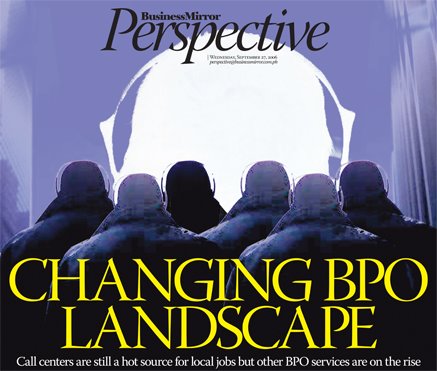
CHANGING BPO LANDSCAPE
CALL CENTERS ARE STILL A HOT SOURCE FOR LOCAL JOBS
BUT OTHER BPO SERVICES ARE ON THE RISE
By David Llorito, Debbie Pepito & Louise Francisco
Research Staff, BusinessMirror
The country’s cyberservices industry appears to be undergoing a transformation. According to BusinessMirror’s Job Ad Index in August, not only is the much-ballyhooed sector getting bigger, it is also expanding into other business activities that may soon blur the difference among the different types of outsourcing services.
For August, BusinessMirror’s Jobs Ads Index rose 18 percentage points from its base in June, driven largely by the continuing demand for workers in cyberservices, construction and engineering, manufacturing, and hotels, restaurants and resorts. For the month, total job ads reached 31,177, about 30 percent of which came from the cyberservices sector. In June, the base on which the index is computed, total job ads reached only 26,216, yet even then cyberservices already accounted for a third of the want ads.
Since May, the research staff of the BusinessMirror has been monitoring job advertisements in the
This research effort is inspired by the Help Wanted Index developed by the Conference Board, a New York-based nonprofit organization that “disseminates knowledge about management and the marketplace to help businesses strengthen their performance and better serve society.”
Outsourcing transformation
Since 2003, prospects of the cyberservices industry have been constantly reported as being hampered by a skills crunch. Yet results of the Job Ads Index in the last three months continue to buck this observation. In August, for instance, jobs advertisements posted by the sector grew 54 percent from its base in June, an indication of its continuing robustness.
For one, the volume of business at the country’s call centers is constantly expanding. Dell Inc., the American computer manufacturer that operates a call center in
“Our
Added country manager Michael Garrison: “We continue to exceed growth plans and are focused on improving the customer experience. We need experienced problem solvers who can simplify and resolve increasingly complex technical and customer-care challenges for home consumers.”
Besides Dell, other heavy job advertisers in the cyberservices sector are Ab Systems, Teletech and Advanced Contact Solutions.
But the sector isn’t just about call centers these days, as there is a growing trend toward other outsourcing activities. Although more than half (52 percent) of the 9,192 job ads posted by the cyberservices sector in August were for call centers, hiring activity was also robust in software development and other IT-enabled services (40 percent) and back-office processing (5 percent). The remaining 5 percent of cyberservices job ads were for animation, medical transcription, and engineering design.
And as the scope of services expands, pretty soon it may not be that easy to classify companies as purely call centers. Accenture, for example, which primarily does software development and back-office work, recently opened its own call center, while call centers like People Support have ventured into medical transcription. Client Logic is also venturing into medical transcription.
“I think there will be a convergence of activities,” observes Frank Holz, chief executive of consultancy firm Outsource2Philippines. “A lot of these guys are doing call-center work but they’re also doing BPO [back-office] work for the same client. So on one hand, you’re doing the back-office accounting or you’re doing an HR function. Pretend that somebody has a question about that, they can call in and you got the call-center activity related to that also.”
Holz predicts that although call centers will continue to expand, these companies will eventually venture into other types of BPO work. “The future isn’t as bright [for call centers] as it is for the other types of activities. You might find some arguments on that but that’s how I see it. If you have a certified public accountant doing the books for a company, that’s worth a lot more than a call-center person answering requests for information,” he said.
Perhaps that’s why call centers are now exploring markets other than the English-speaking world. For instance, Link2Support in
“The account itself services mostly English-speaking countries but we do have customers in
“It’s just harder for us to recruit because we’re a technical support account, so we have to consider an applicant’s technical background,” Deato added. “The others are mostly customer-care accounts, so kahit ano’ng course pwede dun. But we do have Spanish-speaking Filipino agents. Marami naman kasi ang mga mestizo dito. It’s just for the Thai, Indonesian and Korean accounts that we have foreigners.”
Convergys, one of the biggest call centers in the country and a Fortune 500 company, has also been seeking multilingual customer-care representatives, particularly those who can speak Mandarin, Fookien and Cantonese. Emerson, an engineering design-outsourcing firm, was also looking for customer-services associates who are fluent in German, French, Italian and Mandarin for Sykes, Emerson’s call-center partner.
There are also those like Prime@ Technology Specialists Inc. that are seeking helpdesk analysts who can converse in Nihonggo and English, while Nihon Software Outsourcing Vision Inc. is in the market for Nihonggo-speaking finance and administrative assistants.
BPO work has become so popular that several entrepreneurs have ventured into setting up their own call centers out of their homes such as Aicom Solutions (telemarketing), Get-A-Filipino (inbound and outbound calls, data processing and medical transcription), Freedom Telework (back office), Agi (Internet content provider) and Jump2Top (Web development, online marketing).
“We have an office coming up in Ortigas area…but the process is taking time and we need to expand quickly, so we thought that home-based operations would be great for our company,” said Roque Lim, sales and marketing assistant of Aicom Solutions. “We did corrective actions first and tried home-based operations and it worked!”
Lim stressed that this is just temporary but he obviously enjoys the convenience of the present setup.
“It’s so convenient, comfortable and flexible…. I can work in pajamas,” said Lim. “At the same time, you don’t have to have the hassle of traveling, no transportation cost. When you work in call centers, there’s a graveyard shift, and when you go out, it’s kind of dangerous. Working at home, you may feel uncomfortable working graveyard shift but you are safe.”
Factories and hotels
Apart from cyberservices, hiring in the construction and engineering sector also continues to be strong with job placements totaling 5,125 in August, a 22-percent jump from its base in June. As in the last three months, however, the bulk of these jobs—85 percent—are overseas, mostly in the petroleum industry in the Middle East and Nigeria—no doubt an effect of oil money being funneled back into oil and gas exploration, as well as modernization activities by the Gulf states.
The manufacturing sector also continues its hiring binge, with 3,037 job-placement ads in August, an increase of 22 percent from its base in June. Major advertisers include companies in food, furniture and fixtures, printing and publishing, chemical and chemical products, and metals. About 20 percent of the total manufacturing jobs are for overseas positions. In fact, most of the job placements in several industries such as rubber products, petroleum and coal, and nonmetallic mineral products are for abroad.
Business at hotels, restaurants and resorts seem to be doing well, too, given that the job ads in the hospitality industry rose 38 percent in August from its base in June. The continuing rise in visitor arrivals and the ripple effect generated by the outsourcing industry are among the main factors cited by the hospitality industry. The Hyatt group, for instance, is on the hunt for a banquet manager, a restaurant manager, a chef de partie, as well as engineers and accountants.
“This is more in response to the general growth in business demands,” explained Eugene Tamesis, director for marketing at the fairly new Hyatt Hotel and Casino Manila. “The manning levels when we started hotel operations in 2004 have grown in line with the demands of the business operations. Now with a fully operating hotel, the manning levels also have to be in accordance with the level of operations in our rooms, food and beverage and other operations.”
Tamesis said Hyatt’s occupancy has been rising since it opened two years ago. He said the hotel’s occupancy was at 51 percent at the end of 2005 and is expecting to increase to 65 percent by the end of this year.
“Our hotel has the highest growth percentage in the industry,” he boasted. “Our figures in 2005 were quite modest compared to the others but this year, we are already performing at the same level as our more established competitors.”
Hotels in the business districts of Makati and Ortigas are enjoying close to 90 percent occupancy, owing to the burgeoning outsourcing industry, sources said. Numerous executives from global outsourcing companies are coming to the Philippines to check on their operations, as well as oversee their training programs, thus boosting hotel business.
“Unfortunately, most of the BPO offices are located in Makati and the Ortigas areas,” conceded Hyatt’s Tamesis. “Therefore, growth from this segment is not expected to be as significant in the Manila Bay area, where none of these types of offices are located. However, we do have bookings from the BPO industry from our ‘Gold Passport’ members, Hyatt’s frequent-guest program, where they accumulate points from the number of stays they make in different Hyatt hotels all over the world. But the numbers are not as significant as compared to our traditional supportive industries belonging to shipping and manpower, embassy, government, pharmaceutical and gaming.”
As in the last three months, the global job market continues to weigh on the results of the Job Ads Index. Overall, a third of the job ads were for overseas. This pattern has been consistent in the last three months.
Besides construction and engineering, more than half of the jobs advertised for sectors like health and social work, nonmetallic mineral products, water transport, air transport were for overseas placements.
Nevertheless, ads for local placements are also on the rise. This largely observed in sectors such as agriculture (154 percent), mining and quarrying (51 percent), games and leisure (23 percent), media and entertainment (87 percent), and advertising and promotions (131 percent).
Even the real-estate sector is also enjoying growing confidence as it posted a 40-percent rise.
“There’s really a continuing recovery in construction and real estate in the last three years,” said Mark Taylor, operations officer of Sterling Construction and Development Corp., which produces prefabricated building materials. “In terms of revenue, we expect to grow 100 percent this year.”
Sunday, September 24, 2006
Philippines: from coco chips to microchips
On July 27, Paul Otellini, president and CEO of Intel unveiled to the world its latest and advanced microprocessor, the Intel Core 2 Duo and Intel Core 2 Extreme, packing 291 million transistors yet consuming 40 percent less power. This microprocessor enables computer users to perform several tasks faster, such as writing emails while downloading videos or music and scanning for viruses. What he didn’t tell is that a significant volume of these new microprocessors are assembled, tested, packaged and shipped from the Philippines.
Yes, Filipinos engineers and workers are capable of doing this high-tech stuff.
And more. Each year, Filipino workers and engineers produce 72 million magnetic heads, 36 million, 30 digital signal displays responsible for processing all the calls for mobile phones, 11 million liquid crystal displays, and 11 million optical disk drives. The electronics industry supplies 10 percent of the world’s semiconductor manufacturing business, 50 percent of the world’s production of 2.5 inch hard disk drive, and 10 percent of the world’s production of 3.5 inch hard disk drive. One hundred percent of the brain of cellular phones, of Nokia phones, is done here in the Philippines by Texas Instruments.
Why are we citing these statistical information? It’s to remind us that, despite of the usual political circuses performed by politicians, the Philippines is no longer what it used to be. It has changed a lot and for good. And certain, the country’s electronics industry, together with other globalized sector of the economy, is part of that changing landscape that we Filipinos should be proud of despite the country’s rambunctious politics.
In 1975, about 75 percent of the country’s exports are agriculture-based; these days, 66 percent are composed mostly of electronics. We have gone a long way from selling coconut chips to exporting microchips. This is not to disparage the farms, for its still a very important component of the economy and it pays to nurture them to ensure a broad-based growth. What we are saying here is that the Philippines has diversified a lot. It’s something that we need to encourage even more. Greater diversity means greater growth opportunities.
The industry now exports US$27 billion worth of electronics, mostly components and devices, electronic data processing, consumer electronics, automotive electronics, communication and radar, office equipment, telecommunications, control and instrumentation, and medical and industrial instrumentation.
Eight of the world’s top chipmakers (Texas Instruments, Intel, Philipps, Fairchild, Analog, Sanyo, On Semi and Rohm) and four of the world’s largest producers of hard disk drives (Hitachi, Toshiba, Fujitsu, and NEC) are in the Philippines. Mitsumi—probably the biggest employer next only to the government with its 17,000 workers—manufactures computer peripherals like CR-R and CD-RW. And equally big firms like Amkor, Epson, and Lexmark are here producing integrated circuits, terminal printers, and printheads.
Sure, the industry is still dominated by the Japanese and American investors but Filipino-owned companies are starting to get into the picture. Currently, there are 883 firms doing electronics, 247 of which are locally owned, producing lots of products including time recorders, power supplies, electronic ballasts, global positioning system tracking devices, among others. Firms like Integrated Microelectronics, Ionics, PSI Technologies, and Fastech are Filipino-owned.
Of course, critics have been saying that electronics “don’t have much linkages” with the rest of the Philippine economy. They say that most of the components or inputs of these companies are imported. But these criticisms miss the whole picture. The industry directly hires 400,000 people, provides business opportunities and generate jobs in other sectors like logistics, software development, banks, transportation, food, and beverages. And it provides the much needed diversity that the country needs to grow.
And there’s enough elbow room to grow. Right now, the Philippines actually has a budding silicon design and development industry. Companies like Intel, Rohm, Sanyo, Easix and Bitmicro are into integrated circuit design; Texas Intruments and Fairchild are into integrated circuits packaging and design; Lexmark, Easiz, and Blue Chip are into module and product design; and firms like Canon IT and Tsukiden are into firmware. The country’s test and packaging design capability for microprocessors, digital signal displays, and logic devices has also been strong. And there’s a growing base of suppliers for hard disk drives.
One might probably wonder how the Philippines succeeded as an electronics exporter. A state from one electronics industry executive should provide the explanation: “The Philippines, compared to its neighbors, doesn’t have good infrastructure. It doesn’t have good governance. But it has the best people.”
Which brings us to the main point: there’s nothing wrong with the people. There’s nothing wrong with their entrepreneurial zeal and willingness to work hard. The problem is with governance. If the country’s political leaders could do something about it, the Philippines could achieve more.
Yes, Filipinos engineers and workers are capable of doing this high-tech stuff.
And more. Each year, Filipino workers and engineers produce 72 million magnetic heads, 36 million, 30 digital signal displays responsible for processing all the calls for mobile phones, 11 million liquid crystal displays, and 11 million optical disk drives. The electronics industry supplies 10 percent of the world’s semiconductor manufacturing business, 50 percent of the world’s production of 2.5 inch hard disk drive, and 10 percent of the world’s production of 3.5 inch hard disk drive. One hundred percent of the brain of cellular phones, of Nokia phones, is done here in the Philippines by Texas Instruments.
Why are we citing these statistical information? It’s to remind us that, despite of the usual political circuses performed by politicians, the Philippines is no longer what it used to be. It has changed a lot and for good. And certain, the country’s electronics industry, together with other globalized sector of the economy, is part of that changing landscape that we Filipinos should be proud of despite the country’s rambunctious politics.
In 1975, about 75 percent of the country’s exports are agriculture-based; these days, 66 percent are composed mostly of electronics. We have gone a long way from selling coconut chips to exporting microchips. This is not to disparage the farms, for its still a very important component of the economy and it pays to nurture them to ensure a broad-based growth. What we are saying here is that the Philippines has diversified a lot. It’s something that we need to encourage even more. Greater diversity means greater growth opportunities.
The industry now exports US$27 billion worth of electronics, mostly components and devices, electronic data processing, consumer electronics, automotive electronics, communication and radar, office equipment, telecommunications, control and instrumentation, and medical and industrial instrumentation.
Eight of the world’s top chipmakers (Texas Instruments, Intel, Philipps, Fairchild, Analog, Sanyo, On Semi and Rohm) and four of the world’s largest producers of hard disk drives (Hitachi, Toshiba, Fujitsu, and NEC) are in the Philippines. Mitsumi—probably the biggest employer next only to the government with its 17,000 workers—manufactures computer peripherals like CR-R and CD-RW. And equally big firms like Amkor, Epson, and Lexmark are here producing integrated circuits, terminal printers, and printheads.
Sure, the industry is still dominated by the Japanese and American investors but Filipino-owned companies are starting to get into the picture. Currently, there are 883 firms doing electronics, 247 of which are locally owned, producing lots of products including time recorders, power supplies, electronic ballasts, global positioning system tracking devices, among others. Firms like Integrated Microelectronics, Ionics, PSI Technologies, and Fastech are Filipino-owned.
Of course, critics have been saying that electronics “don’t have much linkages” with the rest of the Philippine economy. They say that most of the components or inputs of these companies are imported. But these criticisms miss the whole picture. The industry directly hires 400,000 people, provides business opportunities and generate jobs in other sectors like logistics, software development, banks, transportation, food, and beverages. And it provides the much needed diversity that the country needs to grow.
And there’s enough elbow room to grow. Right now, the Philippines actually has a budding silicon design and development industry. Companies like Intel, Rohm, Sanyo, Easix and Bitmicro are into integrated circuit design; Texas Intruments and Fairchild are into integrated circuits packaging and design; Lexmark, Easiz, and Blue Chip are into module and product design; and firms like Canon IT and Tsukiden are into firmware. The country’s test and packaging design capability for microprocessors, digital signal displays, and logic devices has also been strong. And there’s a growing base of suppliers for hard disk drives.
One might probably wonder how the Philippines succeeded as an electronics exporter. A state from one electronics industry executive should provide the explanation: “The Philippines, compared to its neighbors, doesn’t have good infrastructure. It doesn’t have good governance. But it has the best people.”
Which brings us to the main point: there’s nothing wrong with the people. There’s nothing wrong with their entrepreneurial zeal and willingness to work hard. The problem is with governance. If the country’s political leaders could do something about it, the Philippines could achieve more.
Monday, September 18, 2006
It's governance, stupid!
ONCE again, the World Bank has released another study which should clearly tell the government where to look if we really want to go forward economically.
Titled “Governance Matters, 2006: Worldwide Governance Indicators,” the study clearly shows that countries high in the ranking on six governance indicators are also the ones enjoying better economic growth, which should also mean higher standards of living for their people.
These variables include voice and accountability measuring political, civil and human rights; political stability measuring likelihood of violence; government effectiveness measuring the competence of the bureaucracy and the quality of public service; regulatory quality measuring the incidence of market-unfriendly policies; rule of law measuring the quality of contract enforcement, the police, the courts and incidence of crime; and control of corruption measuring the abuse of power for private gain including petty and grand theft and the capture of the state by elites.
In terms of voice and accountability, top-ranked in Asia-Pacific are Taiwan, South Korea, Mongolia. The bottom dwellers are Myanmar, North Korea and China. The Philippines is at the middle.
In terms of political stability, those with the highest percentile rank in the Asia-Pacific are Hong Kong, Singapore, Taiwan and Malaysia. The bottom dwellers are the Philippines, Indonesia and Myanmar.
In terms of government effectiveness, the top ones are Singapore, Hong Kong and Taiwan. Among the bottom dwellers are Myanmar, Laos and East Timor. The Philippines is in the middle.
In regulatory quality, the top performers are Hong Kong, Singapore, Taiwan. Those at the bottom are North Korea, Myanmar, Laos. The Philippines again is at the middle.
In rule of law, the top performers are Hong Kong, Singapore and Taiwan. Among the poorest performers are Myanmar, North Korea and Cambodia. The Philippines is somewhere at the middle—but lower than China.
And finally, in terms of control of corruption, the top performers are also Singapore, Hong Kong and Taiwan. The bottom dwellers are Myanmar, North Korea and Cambodia. The Philippines once again is somewhere at the middle.
What do these rankings suggest?
Countries at the top of the ranking are those that have achieved a high level of sustained economic growth for several decades. These countries have advanced and high-tech economies and their peoples are richer, enjoying better quality lives. Those near the bottom are usually poorer and their peoples live miserable lives.
The message therefore is very clear. If we want to improve our lives as a people, we should have better governance. That means we should have better government officials.
In simpler terms, we should have national and local leaders who are accountable and who don’t kill dissenters. The practice of extrajudicial killings, especially of activists and journalists, should stop. The government should have a clear program to address this once and for all.
We should have political stability. And what better way to achieve this than addressing the continuing legitimacy questions? In May next year, the Philippines will have a midterm election. Is the Comelec credible enough to preside over a clean and honest one? And, until we see the real thing, talk in government about computerizing the next election will be considered just that—talk.
Government effectiveness certainly plays a great role in economic growth and development. Sad to say, the government, even if it preaches the need to rejuvenate the countryside through massive spending on “super regions,” doesn’t actually have the energy and the ingenuity to put those plans on the ground. This year alone government boasts it actually has P30 billion to spend for crucial infrastructure projects and programs.
The latest information from the National Economic and Development Authority, however, shows that government has only spent P2 billion.
Oh, some bureaucrats must be living fantastic lives looking at their navels, biting their nails, and enjoying their weekly spas while the farmers and the entrepreneurs have to struggle with poor roads, bridges, crowded ports, sluggish public service!
And yet, in the midst of such underspending on crucial socioeconomic services, some geniuses in government could actually get the President to do some spending in the wrong area: how? By repealing her successor’s executive order, which rightly limited the task of providing microcredit to government financial institutions (GFIs), thus encouraging the private sector to provide financing for small and medium enterprises, and correcting a decades-old setup that drained the coffers of government nonfinancial agencies and government-owned and controlled corporations. The repeal, through EO 558, has stirred a hornet’s nest in the private sector, and worried sick our finance and monetary officials who wish to avoid the fiscal nightmares of the past.
On Sunday Finance Secretary Gary Teves who complained about the EO “clarified” that it was a “location-specific order,” after all, one covering only the 47 poorest towns that won’t be serviced by the private sector anyway. But people wait and watch.
A few weeks ago, the World Bank released its report comparing the ease of doing business across countries worldwide. As usual, the Philippines was among the least conducive places. Imagine having to go through a gauntlet of 11 procedures within 48 days just to register a shop selling porridge? This is the main source of corruption in this country and the government had better do something about it before we slip further into the gutter.
And if there’s one factor that really riles investors, it’s the utter lack of palabra de honor among government people, the constant flip-flopping and the unpredictable change of policies midstream. This has become such an international issue among Europeans that no less than the President herself had to “explain” everything to Angela Merkel, the German Chancellor. Well, talk is cheap and investors have yet to see a clear signal on the government going straight on the issue.
Nevertheless, Filipinos are great entrepreneurs. In the last 10 quarters, the Philippine economy has been growing within the 5 percent to 6 percent gross domestic product growth range, courtesy of those dogged entrepreneurs and farmers who simply have not given up despite all the odds. But we could do better than this if only the government shapes up. And soon!
Titled “Governance Matters, 2006: Worldwide Governance Indicators,” the study clearly shows that countries high in the ranking on six governance indicators are also the ones enjoying better economic growth, which should also mean higher standards of living for their people.
These variables include voice and accountability measuring political, civil and human rights; political stability measuring likelihood of violence; government effectiveness measuring the competence of the bureaucracy and the quality of public service; regulatory quality measuring the incidence of market-unfriendly policies; rule of law measuring the quality of contract enforcement, the police, the courts and incidence of crime; and control of corruption measuring the abuse of power for private gain including petty and grand theft and the capture of the state by elites.
In terms of voice and accountability, top-ranked in Asia-Pacific are Taiwan, South Korea, Mongolia. The bottom dwellers are Myanmar, North Korea and China. The Philippines is at the middle.
In terms of political stability, those with the highest percentile rank in the Asia-Pacific are Hong Kong, Singapore, Taiwan and Malaysia. The bottom dwellers are the Philippines, Indonesia and Myanmar.
In terms of government effectiveness, the top ones are Singapore, Hong Kong and Taiwan. Among the bottom dwellers are Myanmar, Laos and East Timor. The Philippines is in the middle.
In regulatory quality, the top performers are Hong Kong, Singapore, Taiwan. Those at the bottom are North Korea, Myanmar, Laos. The Philippines again is at the middle.
In rule of law, the top performers are Hong Kong, Singapore and Taiwan. Among the poorest performers are Myanmar, North Korea and Cambodia. The Philippines is somewhere at the middle—but lower than China.
And finally, in terms of control of corruption, the top performers are also Singapore, Hong Kong and Taiwan. The bottom dwellers are Myanmar, North Korea and Cambodia. The Philippines once again is somewhere at the middle.
What do these rankings suggest?
Countries at the top of the ranking are those that have achieved a high level of sustained economic growth for several decades. These countries have advanced and high-tech economies and their peoples are richer, enjoying better quality lives. Those near the bottom are usually poorer and their peoples live miserable lives.
The message therefore is very clear. If we want to improve our lives as a people, we should have better governance. That means we should have better government officials.
In simpler terms, we should have national and local leaders who are accountable and who don’t kill dissenters. The practice of extrajudicial killings, especially of activists and journalists, should stop. The government should have a clear program to address this once and for all.
We should have political stability. And what better way to achieve this than addressing the continuing legitimacy questions? In May next year, the Philippines will have a midterm election. Is the Comelec credible enough to preside over a clean and honest one? And, until we see the real thing, talk in government about computerizing the next election will be considered just that—talk.
Government effectiveness certainly plays a great role in economic growth and development. Sad to say, the government, even if it preaches the need to rejuvenate the countryside through massive spending on “super regions,” doesn’t actually have the energy and the ingenuity to put those plans on the ground. This year alone government boasts it actually has P30 billion to spend for crucial infrastructure projects and programs.
The latest information from the National Economic and Development Authority, however, shows that government has only spent P2 billion.
Oh, some bureaucrats must be living fantastic lives looking at their navels, biting their nails, and enjoying their weekly spas while the farmers and the entrepreneurs have to struggle with poor roads, bridges, crowded ports, sluggish public service!
And yet, in the midst of such underspending on crucial socioeconomic services, some geniuses in government could actually get the President to do some spending in the wrong area: how? By repealing her successor’s executive order, which rightly limited the task of providing microcredit to government financial institutions (GFIs), thus encouraging the private sector to provide financing for small and medium enterprises, and correcting a decades-old setup that drained the coffers of government nonfinancial agencies and government-owned and controlled corporations. The repeal, through EO 558, has stirred a hornet’s nest in the private sector, and worried sick our finance and monetary officials who wish to avoid the fiscal nightmares of the past.
On Sunday Finance Secretary Gary Teves who complained about the EO “clarified” that it was a “location-specific order,” after all, one covering only the 47 poorest towns that won’t be serviced by the private sector anyway. But people wait and watch.
A few weeks ago, the World Bank released its report comparing the ease of doing business across countries worldwide. As usual, the Philippines was among the least conducive places. Imagine having to go through a gauntlet of 11 procedures within 48 days just to register a shop selling porridge? This is the main source of corruption in this country and the government had better do something about it before we slip further into the gutter.
And if there’s one factor that really riles investors, it’s the utter lack of palabra de honor among government people, the constant flip-flopping and the unpredictable change of policies midstream. This has become such an international issue among Europeans that no less than the President herself had to “explain” everything to Angela Merkel, the German Chancellor. Well, talk is cheap and investors have yet to see a clear signal on the government going straight on the issue.
Nevertheless, Filipinos are great entrepreneurs. In the last 10 quarters, the Philippine economy has been growing within the 5 percent to 6 percent gross domestic product growth range, courtesy of those dogged entrepreneurs and farmers who simply have not given up despite all the odds. But we could do better than this if only the government shapes up. And soon!
Saturday, September 16, 2006
There's no such thing as Islamo-fascism!
Since George Bush adopted the term “Islamo-fascism,” every else started using the term without examining its meaning. In truth there is really no such thing as Islamo-fascism and using it doesn’t serve any purpose in the so-called war on terror both in theoretical and practical sense.
Thursday, September 14, 2006
Drifting to the edge
THERE seems to be no end to the government’s embarrassment from the spate of lectures it has gotten from foreign institutions and organizations— lecturing us to shake up, shape up and change or else the world will leave us behind. The latest comes from no less than Juan Jose Daboub, managing director of the World Bank, who came here from his perch in Washington, D.C., to warn us about how strengthening regional competition is steadily making us bite the dust.
“The strength of regional competitors sounds an alarm bell that this country cannot afford to ignore,” he said. “Time wasted, reforms lapse, large segments of the population with untapped potential, continued tolerance of corrupt practices, will have a real price, not just in lost income and lost market share, but lost opportunity for millions of Filipinos.”
But of course, the message from the top WB honcho, one that has been obvious years ago, is only the latest. Last week, WB’s private sector financing arm, the International Finance Corporation, announced that the Philippines has among the lousiest business environments in Asia-Pacific because of the increasing tangle of regulations that the government has put in the way of entrepreneurship. It’s funny that an entrepreneur has to take 11 steps and completes the process of registering his business in 48 days. It’s funnier still that the government doesn’t seem to recognize the problem. After the announcement of that study, one expected the government to initiate a program to address the problem, or at least dispute or reckon with it. But, no reaction. It’s as if the IFC is just dreaming crazy dreams.
Last week, stakeholders in the mining industry canceled their big international conference after their frustrations about the government’s flip-flopping and indifference reached a breaking point. They thought all along that since the government has formulated a “minerals action plan” it would firm up its policy about the industry. The private sector, led on by government, conducted road shows all over the globe and when the investors came, they found Malacañang suddenly disinterested—or at least, mouthing interest while sending conflicting signals.
Of course, the French, the Spaniards and the Germans have been complaining about the mixed signals and inconsistent policies. They have been reaching out to the government functionaries but they don’t seem to get across.
What’s happening here? This is alarming because it means two things. First—it means that international observers are finding that this country, specifically its leaders and policymakers, are dozing off while other countries are scrambling to reform their policies and procedures. And second—it seems to suggest that the government is in total disarray and drift. It portrays an administration that has totally lost its energy to do its job, to perform even its basic functions, even just to attend meetings.
When leaders of international organizations—people who are steeped in diplomatese—speak about what’s wrong with us we better listen hard. That means they see a boat being carried away by the current of sheer inertia, drifting dangerously toward the edge, and everyone onboard seems to have totally lost situational awareness.
“The strength of regional competitors sounds an alarm bell that this country cannot afford to ignore,” he said. “Time wasted, reforms lapse, large segments of the population with untapped potential, continued tolerance of corrupt practices, will have a real price, not just in lost income and lost market share, but lost opportunity for millions of Filipinos.”
But of course, the message from the top WB honcho, one that has been obvious years ago, is only the latest. Last week, WB’s private sector financing arm, the International Finance Corporation, announced that the Philippines has among the lousiest business environments in Asia-Pacific because of the increasing tangle of regulations that the government has put in the way of entrepreneurship. It’s funny that an entrepreneur has to take 11 steps and completes the process of registering his business in 48 days. It’s funnier still that the government doesn’t seem to recognize the problem. After the announcement of that study, one expected the government to initiate a program to address the problem, or at least dispute or reckon with it. But, no reaction. It’s as if the IFC is just dreaming crazy dreams.
Last week, stakeholders in the mining industry canceled their big international conference after their frustrations about the government’s flip-flopping and indifference reached a breaking point. They thought all along that since the government has formulated a “minerals action plan” it would firm up its policy about the industry. The private sector, led on by government, conducted road shows all over the globe and when the investors came, they found Malacañang suddenly disinterested—or at least, mouthing interest while sending conflicting signals.
Of course, the French, the Spaniards and the Germans have been complaining about the mixed signals and inconsistent policies. They have been reaching out to the government functionaries but they don’t seem to get across.
What’s happening here? This is alarming because it means two things. First—it means that international observers are finding that this country, specifically its leaders and policymakers, are dozing off while other countries are scrambling to reform their policies and procedures. And second—it seems to suggest that the government is in total disarray and drift. It portrays an administration that has totally lost its energy to do its job, to perform even its basic functions, even just to attend meetings.
When leaders of international organizations—people who are steeped in diplomatese—speak about what’s wrong with us we better listen hard. That means they see a boat being carried away by the current of sheer inertia, drifting dangerously toward the edge, and everyone onboard seems to have totally lost situational awareness.
Monday, September 11, 2006
Is the Philippines a stalinist society?
IS the Philippines a Stalinist society or what? Just by looking at the regulatory barriers being put up by the government on business activity, one might think Filipinos live under a highly regimented, bureaucratic and authoritarian form of government and not a free society.
On the other hand, we are probably not a free society. Consider the findings of the International Finance Corporation, the private investment arm of the World Bank, on the “ease of doing business” released the other day:
It takes 11 steps to launch a business over 48 days on average. In the rest of the Asia Pacific Region, one only needs eight steps over 46 days. In advanced countries, particularly the members of the Organization for Economic Cooperation and Development (OECD) composed of the United States, Britain, Japan, Belgium, Australia, Canada, among others, all one needs is six steps over 16 days.
Surely, an entrepreneur would need to get licenses and permits to operate a business. An entrepreneur in the Philippines would need 197 steps and 23 days to complete the process. In the Asia-Pacific Region, all it takes is 18 days, and in the OECD countries 14 days.
You want to register a property? It takes eight steps over 33 days here against only four steps over 86 days in Asia-Pacific. In OECD, it takes five steps over 32 days.
Even closing a business takes a lot of hassle. The process takes almost six steps over 38 days, as against two steps over 23 days in Asia-Pacific. In OECD, one only needs a step to close a business over seven days.
The report also highlights the “rigidity” of the country’s labor markets, indicating the entrepreneurs’ difficulties in hiring and firing, thus hindering the creation of more jobs.
Overall, the Philippines ranked 126 over 175 countries, indicating a certain unfriendliness to business and entrepreneurship. When ranked per category, the IFC report shows that the Philippines ranked 108 in terms of ease to start a business, 113 in dealing with licenses, 118 on the employment of workers, 98 on registering a property, 101 on getting credit, 151 on protection to investors, 101 on paying taxes, 63 on trading across borders, 59 on the enforcement of contracts, and 147 on closing a business. Worse, we ranked 121 in 2005, an indication that we are not reforming our bureaucracy!
Conclusion? Despite our pretensions to private-sector led development, this country is not yet fully open for business. Nobel Prize economist Amartya Sen argues that the citizen’s freedom to transact business with one another is part of human rights.
Development, according to Sen, is all about choice and certainly this tangle of regulations suggests that the state is depriving the people of their right to grow and prosper.
Right now, the Philippines is saddled with a lot of challenges: joblessness, high underemployment, high cost of living, diaspora of skilled professionals, poverty, rapid rural-to-urban migration, criminality, low quality of life, and low tax intake.
The State could not address all these problems. These are essentially economic issues that could be addressed quickly by higher economic growth. When entrepreneurs are free to set up business, and the regulatory environment are conducive, they are going to hire people who would have the purchasing power to buy goods and services and send their children to school, thus setting up an upward spiral of economic activities. When people find it easy to set up shop, they are likely to register their business, thus boosting the country’s tax base. These are fairly simple truths that the government needs to recognize and do something about.
In the last State of the Nation Address, President Arroyo said that the government is allocating billions of pesos for mega infrastructure projects. That is nice, except that the roads, bridges and highways and structures that such government money will build will not yield optimal economic returns to society if entrepreneurs are shackled by crippling regulations.
Supposedly, reforming the tangle of regulations is easier to achieve. The government will not spend much effecting these changes. All the government needs to do is muster its will for change and streamline its operations.
On the other hand, we are probably not a free society. Consider the findings of the International Finance Corporation, the private investment arm of the World Bank, on the “ease of doing business” released the other day:
It takes 11 steps to launch a business over 48 days on average. In the rest of the Asia Pacific Region, one only needs eight steps over 46 days. In advanced countries, particularly the members of the Organization for Economic Cooperation and Development (OECD) composed of the United States, Britain, Japan, Belgium, Australia, Canada, among others, all one needs is six steps over 16 days.
Surely, an entrepreneur would need to get licenses and permits to operate a business. An entrepreneur in the Philippines would need 197 steps and 23 days to complete the process. In the Asia-Pacific Region, all it takes is 18 days, and in the OECD countries 14 days.
You want to register a property? It takes eight steps over 33 days here against only four steps over 86 days in Asia-Pacific. In OECD, it takes five steps over 32 days.
Even closing a business takes a lot of hassle. The process takes almost six steps over 38 days, as against two steps over 23 days in Asia-Pacific. In OECD, one only needs a step to close a business over seven days.
The report also highlights the “rigidity” of the country’s labor markets, indicating the entrepreneurs’ difficulties in hiring and firing, thus hindering the creation of more jobs.
Overall, the Philippines ranked 126 over 175 countries, indicating a certain unfriendliness to business and entrepreneurship. When ranked per category, the IFC report shows that the Philippines ranked 108 in terms of ease to start a business, 113 in dealing with licenses, 118 on the employment of workers, 98 on registering a property, 101 on getting credit, 151 on protection to investors, 101 on paying taxes, 63 on trading across borders, 59 on the enforcement of contracts, and 147 on closing a business. Worse, we ranked 121 in 2005, an indication that we are not reforming our bureaucracy!
Conclusion? Despite our pretensions to private-sector led development, this country is not yet fully open for business. Nobel Prize economist Amartya Sen argues that the citizen’s freedom to transact business with one another is part of human rights.
Development, according to Sen, is all about choice and certainly this tangle of regulations suggests that the state is depriving the people of their right to grow and prosper.
Right now, the Philippines is saddled with a lot of challenges: joblessness, high underemployment, high cost of living, diaspora of skilled professionals, poverty, rapid rural-to-urban migration, criminality, low quality of life, and low tax intake.
The State could not address all these problems. These are essentially economic issues that could be addressed quickly by higher economic growth. When entrepreneurs are free to set up business, and the regulatory environment are conducive, they are going to hire people who would have the purchasing power to buy goods and services and send their children to school, thus setting up an upward spiral of economic activities. When people find it easy to set up shop, they are likely to register their business, thus boosting the country’s tax base. These are fairly simple truths that the government needs to recognize and do something about.
In the last State of the Nation Address, President Arroyo said that the government is allocating billions of pesos for mega infrastructure projects. That is nice, except that the roads, bridges and highways and structures that such government money will build will not yield optimal economic returns to society if entrepreneurs are shackled by crippling regulations.
Supposedly, reforming the tangle of regulations is easier to achieve. The government will not spend much effecting these changes. All the government needs to do is muster its will for change and streamline its operations.
Wednesday, September 06, 2006
Those lazy bankers!
Are the country’s banks serving well the country’s development needs? Policymakers should closely consider this question. Last week, no less than Romulo Neri, the country’s top economic planner who said that banks so far has been engaged largely in “lazy banking” or content on harvesting profits off people’s purchases of cellular phones and appliances at the expense of “project financing” (funding tangible development projects) for that the country needs for economic takeoff.
Neri said the country the country now is awash with cash, a significant portion of which are OFW money, and that the country’s savings rate is now high at about 30 percent of GDP as compared to about 20 percent in 2000. Had banks been more engaged in project financing, the county could have achieved better performance than the 5.6 percent growth rate that the country has achieved in the first half, thus creating enough jobs to make a dent on joblessness.
The Philippine economy has been growing within the 5-6 percent range at least in the last ten quarters. It’s not as good as China’s or India’s but that growth rate is decent enough to enrich certain sectors. Certainly, the banking sector is one of those beneficiaries of a buoyant economy. In fact, within the same period, the banking sector has been growing at double digit rates, reaching even as high as 27 percent in the third quarter of 2005. The banking sector, therefore, never had it so good. But where did the banks get those impressive growth rates?
Apparently, not so much from lending. In the first half of the year, loans outstanding by commercial banks barely grew by 1 percent. Lending on productive sectors of the economy like agriculture were stagnant (loans outstanding to agriculture grew only by 2.8 and to manufacturing by -7 percent in the first six months of the year). They probably got those impressive growth rates from handling remittances from overseas workers, and financing consumption like cellular phones, cars, and other purchases through the credit cards.
From this statistical information alone, one could see why Neri is complaining about the weak performance of banks. It shows that banks are simply too happy making money off the sweat of OFWs and ordinary workers without taking the risk of investing in tangible and job-creating projects.
What explains this very conservative behavior? One explanation is probably lack of confidence in the short and medium prospects of the economy. But this explanation is funny because the Philippine has been doing quite well in the last two years. Latest survey by the Bangko Sentral ng Pilipinas indicates that the private business sector is optimistic about the future.
The usual suspect of course is the high percentage of non-performing loans among banks’s lending portfolio. However, it shows that the banks’ NPL ratios have actually been improving in the last few years. In May, for instance, the banks’ NPL is down to about 7 percent, a significant improvement from last year’s 11 percent.
The most plausible explanation probably is low capital base among banks. Neri seems inclined to believe this angle. Solution? Why not raise the bank’s capital base by allowing infusion from investors? This sounds so elementary but it’s a scenario that is not likely fly given the nature of ownership in Philippine banks. Banks usually are family-owned hence raising their capital base would dilute ownership, something that most families don’t like.
The ultimate solution therefore lies with opening the banking sector to more competition. This could be done in several ways like allowing one hundred percent ownership by foreign investors. Another is by liberalizing the opening of bank branches to introduce more market competition. And the best is combining the two policy measures. If anybody could invest in sari-sari stores or in a manufacturing plant producing hotdogs without the government telling them how much percent ownership they could have and where to put their plants, government should allow the same rules of the game within the banking sector to introduce more competition and efficiency.
Neri said the country the country now is awash with cash, a significant portion of which are OFW money, and that the country’s savings rate is now high at about 30 percent of GDP as compared to about 20 percent in 2000. Had banks been more engaged in project financing, the county could have achieved better performance than the 5.6 percent growth rate that the country has achieved in the first half, thus creating enough jobs to make a dent on joblessness.
The Philippine economy has been growing within the 5-6 percent range at least in the last ten quarters. It’s not as good as China’s or India’s but that growth rate is decent enough to enrich certain sectors. Certainly, the banking sector is one of those beneficiaries of a buoyant economy. In fact, within the same period, the banking sector has been growing at double digit rates, reaching even as high as 27 percent in the third quarter of 2005. The banking sector, therefore, never had it so good. But where did the banks get those impressive growth rates?
Apparently, not so much from lending. In the first half of the year, loans outstanding by commercial banks barely grew by 1 percent. Lending on productive sectors of the economy like agriculture were stagnant (loans outstanding to agriculture grew only by 2.8 and to manufacturing by -7 percent in the first six months of the year). They probably got those impressive growth rates from handling remittances from overseas workers, and financing consumption like cellular phones, cars, and other purchases through the credit cards.
From this statistical information alone, one could see why Neri is complaining about the weak performance of banks. It shows that banks are simply too happy making money off the sweat of OFWs and ordinary workers without taking the risk of investing in tangible and job-creating projects.
What explains this very conservative behavior? One explanation is probably lack of confidence in the short and medium prospects of the economy. But this explanation is funny because the Philippine has been doing quite well in the last two years. Latest survey by the Bangko Sentral ng Pilipinas indicates that the private business sector is optimistic about the future.
The usual suspect of course is the high percentage of non-performing loans among banks’s lending portfolio. However, it shows that the banks’ NPL ratios have actually been improving in the last few years. In May, for instance, the banks’ NPL is down to about 7 percent, a significant improvement from last year’s 11 percent.
The most plausible explanation probably is low capital base among banks. Neri seems inclined to believe this angle. Solution? Why not raise the bank’s capital base by allowing infusion from investors? This sounds so elementary but it’s a scenario that is not likely fly given the nature of ownership in Philippine banks. Banks usually are family-owned hence raising their capital base would dilute ownership, something that most families don’t like.
The ultimate solution therefore lies with opening the banking sector to more competition. This could be done in several ways like allowing one hundred percent ownership by foreign investors. Another is by liberalizing the opening of bank branches to introduce more market competition. And the best is combining the two policy measures. If anybody could invest in sari-sari stores or in a manufacturing plant producing hotdogs without the government telling them how much percent ownership they could have and where to put their plants, government should allow the same rules of the game within the banking sector to introduce more competition and efficiency.
Subscribe to:
Posts (Atom)