I could not understand how the Bureau of Agricultural Statistics (BAS) could say that in 2005 the farm sector has “surpassed” its 2004 performance. In 2005, the farm sector grew only by 2.24 percent in real terms (relative to 2004) as against 5.10 in 2004 (relative to 2003). Isn’t that clear enough?
Maybe they used the term “surpassed” to mean that the value of farm production in 2005 at current prices is almost 6 percent higher than the previous year’s figure. That’s true but “performance” is usually associated with growth in output in real terms and not in terms of increments in output. That’s a big difference. No sir! Philippine agriculture did not “surpass” its 2004 performance.
I’m not sure whether or not the BAS is deliberately lying or plain bullshitting. Lying is better because it means it is deliberately hiding the truth and, in effect, affirming it. But bullshitting is worse because it means BAS is telling us something with complete disregard for truth or facts. In his book “On Bullshit,” Princeton-based writer Harry Frankfurt said a bullshitter is he who "does not reject the authority of the truth, as the liar does, and oppose himself to it. He pays no attention to it at all. By virtue of this, bullshit is a greater enemy of the truth than lies are."
Nevertheless, a 2.24 percent is good enough considering El Niño that affected a lot of farms. It would surely boost growth of the overall economy. With this level of farm output, a GDP growth rate in the vicinity of 5 percent, given the continuing strength of the manufacturing and the services sectors, is possible.
Note:You may visit Photographs and Memories for my more personal reflections about the world. HAPPY WEEKEND TO ALL!!!
Thursday, January 19, 2006


Wednesday, January 18, 2006
Photographs and memories: Introducing my new personal blog
Hello to the world! I would just like to let you know I've set up another blog entitled "Photographs and Memories." This one will contain my reflections about things trivial, non-cerebral, and down-to-earth matters about life as we know it. It will also contain some stills of life, nay memorable photographs reflecting the highs and lows of my existence (oh my, does it read like Sartreian angst?), including some pictures of my recent trip to the United States under the State Department's International Visitors Program. That visit was definitely a high point of my life. To visit my new blog, just click on the link. Thanks and have a nice day!
Cutting Red tape means hitting several birds with one stone
WE thought all along that the forces of globalization have slowly transformed the Philippines into a better place for business. Since 1995, policymakers have reduced tariff, removed most of the nontariff barriers and aligned many of our domestic economic policies with the World Trade Organization. We thought all along that we have started to allow the "invisible hand" of the market to guide economic decisions. The recent report of the International Finance Corporation (IFC), the investment arm of the World Bank, simply blew away those illusions. We are actually one of the most difficult places on earth to do business.
The IFC-World Bank Report says that in 2006, the Philippines ranked 113 out of 155 countries in the world in terms of "ease of doing business," just a notch higher than Iraq (ranked 114). This ranking means that in the Philippines it requires Herculean efforts just to do the basic thing like setting up a business, complying with licenses and permits, hiring and firing of employees, registering a property, getting credit, enforcing contracts, paying taxes or closing the business.
This status is not flattering at all. For ranking at 113, the Philippines shares the poor status with Mozambique (ranked 110), Bolivia (111), Honduras (112), Iraq (114), Indonesia (115), India (116), and Albania (117), Croatia (118), Brazil (119) and Venezuela (120).
Now we know the real reason why the country does not grow as fast as the roaring economies in the Asia-Pacific region. Many used to blame the "political noise" or the irrational exuberance of democracy for our failure to catch to progress. They have a point there. But that's really a peripheral issue; the real culprits are the dead and calloused hands of the State that are sapping the country's entrepreneurial energy.
How could we attract more investments when even in just opening a simple business store the government requires one to go through 11 steps within 48 days to complete the process costing 20 percent of one's gross per capita income? Consider this: when an entrepreneur wants to start a business he or she needs to obtain the following requirements: proof of funds or capital, registration with the Securities and Exchange Commission, barangay clearance, mayor's permit, purchase of books of account, registration for the value-added tax, a tax identification number, payment of documentary stamp taxes, authority to print invoices, printing of receipts and invoices, registration of those receipts and invoices, and filings for social security and medicare.
Why should foreign investors come when they would have an easier time setting up businesses in New Zealand , Singapore , United States , Canada , Norway , Australia , Hong Kong , Denmark , United Kingdom and Japan . Among Asian countries, Thailand , Malaysia and Korea ?
We want to solve the fiscal crisis? Then let's remove all these barriers to investments. One of the main reasons why the Philippines has a low tax base is because more than half of the country's economy is accounted for by the informal sector. This sector is largely composed of small unregistered family-operated businesses that do not pay taxes. Because of the high cost of registering business both in terms of money and time, they would rather stay underground thus depriving the government of much-needed revenue. But once the barriers to entry are brought down, the government would have a larger tax base as micro, small, and medium enterprises would find that the benefits of formalizing the business, such as greater access to credit and better utilities, far outweigh the amount that the entrepreneur pays the government in terms of taxes and fees.
We want to create more jobs and reduce poverty in this country? The shortest path is removing all these regulatory and bureaucratic tangles. With many entrepreneurs setting up businesses we create more jobs and more economic activities that even create more jobs. The bonus to this is that, as more firms go formal, there would be more quality jobs that are protected by social security, health insurance, work safety regulations, and nonmonetary benefits like vacation leaves.
We want to lick graft and corruption in the bureaucracy? Again, removing all these messy and unnecessary regulations is the key. The more complex the regulations, the more that bureaucrats would have opportunities to extort bribes from those trying to make an honest living through entrepreneurship. By reforming the country's business and economic regulatory system, the government therefore will hit several stones with just one shot. And the government should do it now with greater urgency and zeal because the future of the country's economy rests on this reform initiative.
In the recent IFC-WB report, countries like Serbia and Montenegro , Georgia , Vietnam , Slovakia , Egypt , Romania , Finland , Pakistan and Rwanda are reforming their regulatory systems hard and fast. These facts simply mean that the competition for foreign direct investments is getting keener by the day. If the government continues to procrastinate, the Philippines—like Rip Van Winkle—will wake up one day to a totally different world where most of those reformers are wining and dining in an exclusive rich man's club while Filipinos are wallowing in self-pity and misery.
The IFC-World Bank Report says that in 2006, the Philippines ranked 113 out of 155 countries in the world in terms of "ease of doing business," just a notch higher than Iraq (ranked 114). This ranking means that in the Philippines it requires Herculean efforts just to do the basic thing like setting up a business, complying with licenses and permits, hiring and firing of employees, registering a property, getting credit, enforcing contracts, paying taxes or closing the business.
This status is not flattering at all. For ranking at 113, the Philippines shares the poor status with Mozambique (ranked 110), Bolivia (111), Honduras (112), Iraq (114), Indonesia (115), India (116), and Albania (117), Croatia (118), Brazil (119) and Venezuela (120).
Now we know the real reason why the country does not grow as fast as the roaring economies in the Asia-Pacific region. Many used to blame the "political noise" or the irrational exuberance of democracy for our failure to catch to progress. They have a point there. But that's really a peripheral issue; the real culprits are the dead and calloused hands of the State that are sapping the country's entrepreneurial energy.
How could we attract more investments when even in just opening a simple business store the government requires one to go through 11 steps within 48 days to complete the process costing 20 percent of one's gross per capita income? Consider this: when an entrepreneur wants to start a business he or she needs to obtain the following requirements: proof of funds or capital, registration with the Securities and Exchange Commission, barangay clearance, mayor's permit, purchase of books of account, registration for the value-added tax, a tax identification number, payment of documentary stamp taxes, authority to print invoices, printing of receipts and invoices, registration of those receipts and invoices, and filings for social security and medicare.
Why should foreign investors come when they would have an easier time setting up businesses in New Zealand , Singapore , United States , Canada , Norway , Australia , Hong Kong , Denmark , United Kingdom and Japan . Among Asian countries, Thailand , Malaysia and Korea ?
We want to solve the fiscal crisis? Then let's remove all these barriers to investments. One of the main reasons why the Philippines has a low tax base is because more than half of the country's economy is accounted for by the informal sector. This sector is largely composed of small unregistered family-operated businesses that do not pay taxes. Because of the high cost of registering business both in terms of money and time, they would rather stay underground thus depriving the government of much-needed revenue. But once the barriers to entry are brought down, the government would have a larger tax base as micro, small, and medium enterprises would find that the benefits of formalizing the business, such as greater access to credit and better utilities, far outweigh the amount that the entrepreneur pays the government in terms of taxes and fees.
We want to create more jobs and reduce poverty in this country? The shortest path is removing all these regulatory and bureaucratic tangles. With many entrepreneurs setting up businesses we create more jobs and more economic activities that even create more jobs. The bonus to this is that, as more firms go formal, there would be more quality jobs that are protected by social security, health insurance, work safety regulations, and nonmonetary benefits like vacation leaves.
We want to lick graft and corruption in the bureaucracy? Again, removing all these messy and unnecessary regulations is the key. The more complex the regulations, the more that bureaucrats would have opportunities to extort bribes from those trying to make an honest living through entrepreneurship. By reforming the country's business and economic regulatory system, the government therefore will hit several stones with just one shot. And the government should do it now with greater urgency and zeal because the future of the country's economy rests on this reform initiative.
In the recent IFC-WB report, countries like Serbia and Montenegro , Georgia , Vietnam , Slovakia , Egypt , Romania , Finland , Pakistan and Rwanda are reforming their regulatory systems hard and fast. These facts simply mean that the competition for foreign direct investments is getting keener by the day. If the government continues to procrastinate, the Philippines—like Rip Van Winkle—will wake up one day to a totally different world where most of those reformers are wining and dining in an exclusive rich man's club while Filipinos are wallowing in self-pity and misery.
Tuesday, January 17, 2006
Despite globalization, it's still difficult to do business in the Philippines
Last Monday I came across the latest “Doing Business Index” report preparred by the International Finance Corporation ranking countries worldwide on the ease of doing business. Sad to say, the Philippines did not do well in this report, ranking only 113 out of 155 countries. Now we know why the Philippine economy is not growing that fast. Below is my story that appeared as banner article of the BusinessMirror (18 January 2006).
THE Philippines remains to be among the world's most difficult countries to do business in, ranking a poor 113 out of 155 countries worldwide in the recent International Finance Corporation's 2006 global ranking on the "ease of doing business." With such rank, the Philippines is just a notch higher than Iraq.
The most business-friendly countries, the International Finance Corporation (IFC) said, is New Zealand—ranked number 1—followed by Singapore, United States, Canada, Norway, Australia, Hong Kong, Denmark, United Kingdom, and Japan. Among Asian countries, Thailand, Malaysia and Korea belong to the top 20.
The International Finance Corporation, the investment arm of the World Bank that celebrated its 50th anniversary Tuesday, provides loans, risk management services and structured finance products to developing countries worldwide.
In ranking countries, the IFC and the World Bank used 10 variables: the ease of starting a business, ease of dealing with licenses, ease of hiring and firing, ease of registering property, ease of getting credit, ease of protecting investors, ease of paying taxes, ease of trading, ease of enforcing contracts and ease of closing a business.
"[A] high ranking on the ease of doing business does mean that the government has created a regulatory environment conducive to the operation of business," said IFC and the World Bank in its report titled "Doing Business in 2006: Creating Jobs."
The report said: "Often, improvements on the Doing Business indicators proxy for broader reforms to laws and institutions which affect more than the administrative procedures and time and cost of complying with business regulations."
For ranking 113, the Philippines shares the poor status with Mozambique (ranked 110), Bolivia (111), Honduras (112), Iraq (114), Indonesia (115), India (116), and Albania (117), Croatia (118), Brazil (119) and Venezuela (120).
The WB-IFC report clarified that a high ranking in the Doing Business Index does not mean that countries like New Zealand, Singapore, United States, Canada and Norway have little or no regulation.
"All the top-ranking countries regulate businesses, but they do so in less costly and burdensome ways," said the WB-IFC report.
Nordic countries like Norway (ranked 5), Denmark (8), Iceland (12), Finland (13) and Sweden (14) do have regulations, but these regulations are simple, thus allowing businesses to be productive by focusing government intervention where it counts-protecting property rights and providing social services.
The IFC-WB report complains of the Philippines 's tangle of bureaucratic requirements as a major barrier to entrepreneurship.
"Entrepreneurs can expect to go through 11 steps to launch a business over 48 days on average, at a cost equal to 20.3 percent of gross national income (GNI) per capita," said the report. "They must deposit at least 2.0 percent of GNI per capita in a bank to obtain a business registration number."
The same report said that in Thailand (ranked 20) it just takes eight steps to launch a business over 33 days, at a much cheaper cost equal to 6 percent of the GNI per capita and without any required deposit.
Undoing these bureaucratic tangles and unreasonable regulations, the IFC-WB report said, is necessary for the economy to grow faster and create more jobs.
"An increasing number of those jobs will be in the formal economy because of the benefits of being formal (such as easier access to credit and better utility services) often outweigh the costs (such as taxes)," the report said. "And more formal jobs will mean that more workers are protected by pensions, safety regulations, and health benefits."
The report has noted that in complying with licensing and permit requirements alone would take 23 steps and 197 days to complete the process at a cost equivalent to 121 percent of income per capita. For the same activity in Thailand, an entrepreneur there would need nine steps and 147 days to complete the process at a cost of only 17 percent of income per capita.
"In Thailand, it takes two steps and two days to register a property. The cost to register property is 6.3 percent of overall property value," the WB-IFC report said. "In the Philippines, it takes eight steps and 33 days to register property, [at a cost of] 5.7 percent of overall property value."
Even the procedures involved in simply paying taxes—where people give money to the government—have been described as more difficult in the Philippines.
"The effective tax that a medium size company in the Philippines must pay or withhold within a year... Entrepreneurs there must make 62 payments, spend 94 hours, and pay 46.4 percent of gross profit in taxes," said the WB-IFC report. "Entrepreneurs there [Thailand] must make 44 payments, spend 52 hours and pay 29.2 percent of gross profit in taxes."
THE Philippines remains to be among the world's most difficult countries to do business in, ranking a poor 113 out of 155 countries worldwide in the recent International Finance Corporation's 2006 global ranking on the "ease of doing business." With such rank, the Philippines is just a notch higher than Iraq.
The most business-friendly countries, the International Finance Corporation (IFC) said, is New Zealand—ranked number 1—followed by Singapore, United States, Canada, Norway, Australia, Hong Kong, Denmark, United Kingdom, and Japan. Among Asian countries, Thailand, Malaysia and Korea belong to the top 20.
The International Finance Corporation, the investment arm of the World Bank that celebrated its 50th anniversary Tuesday, provides loans, risk management services and structured finance products to developing countries worldwide.
In ranking countries, the IFC and the World Bank used 10 variables: the ease of starting a business, ease of dealing with licenses, ease of hiring and firing, ease of registering property, ease of getting credit, ease of protecting investors, ease of paying taxes, ease of trading, ease of enforcing contracts and ease of closing a business.
"[A] high ranking on the ease of doing business does mean that the government has created a regulatory environment conducive to the operation of business," said IFC and the World Bank in its report titled "Doing Business in 2006: Creating Jobs."
The report said: "Often, improvements on the Doing Business indicators proxy for broader reforms to laws and institutions which affect more than the administrative procedures and time and cost of complying with business regulations."
For ranking 113, the Philippines shares the poor status with Mozambique (ranked 110), Bolivia (111), Honduras (112), Iraq (114), Indonesia (115), India (116), and Albania (117), Croatia (118), Brazil (119) and Venezuela (120).
The WB-IFC report clarified that a high ranking in the Doing Business Index does not mean that countries like New Zealand, Singapore, United States, Canada and Norway have little or no regulation.
"All the top-ranking countries regulate businesses, but they do so in less costly and burdensome ways," said the WB-IFC report.
Nordic countries like Norway (ranked 5), Denmark (8), Iceland (12), Finland (13) and Sweden (14) do have regulations, but these regulations are simple, thus allowing businesses to be productive by focusing government intervention where it counts-protecting property rights and providing social services.
The IFC-WB report complains of the Philippines 's tangle of bureaucratic requirements as a major barrier to entrepreneurship.
"Entrepreneurs can expect to go through 11 steps to launch a business over 48 days on average, at a cost equal to 20.3 percent of gross national income (GNI) per capita," said the report. "They must deposit at least 2.0 percent of GNI per capita in a bank to obtain a business registration number."
The same report said that in Thailand (ranked 20) it just takes eight steps to launch a business over 33 days, at a much cheaper cost equal to 6 percent of the GNI per capita and without any required deposit.
Undoing these bureaucratic tangles and unreasonable regulations, the IFC-WB report said, is necessary for the economy to grow faster and create more jobs.
"An increasing number of those jobs will be in the formal economy because of the benefits of being formal (such as easier access to credit and better utility services) often outweigh the costs (such as taxes)," the report said. "And more formal jobs will mean that more workers are protected by pensions, safety regulations, and health benefits."
The report has noted that in complying with licensing and permit requirements alone would take 23 steps and 197 days to complete the process at a cost equivalent to 121 percent of income per capita. For the same activity in Thailand, an entrepreneur there would need nine steps and 147 days to complete the process at a cost of only 17 percent of income per capita.
"In Thailand, it takes two steps and two days to register a property. The cost to register property is 6.3 percent of overall property value," the WB-IFC report said. "In the Philippines, it takes eight steps and 33 days to register property, [at a cost of] 5.7 percent of overall property value."
Even the procedures involved in simply paying taxes—where people give money to the government—have been described as more difficult in the Philippines.
"The effective tax that a medium size company in the Philippines must pay or withhold within a year... Entrepreneurs there must make 62 payments, spend 94 hours, and pay 46.4 percent of gross profit in taxes," said the WB-IFC report. "Entrepreneurs there [Thailand] must make 44 payments, spend 52 hours and pay 29.2 percent of gross profit in taxes."
Monday, January 16, 2006
Dollar remittances and social paralysis (or the flipside of Philippine overseas employment)
LAST Friday, the Bangko Sentral ng Pilipinas (BSP) happily announced that remittances from overseas Filipino workers (OFW) coursed through commercial banks from January to November last year reached US$9.7 billion, a 26-percent rise from last year’s US$7.7 inflows. The BSP attributed this double-digit growth in dollar remittances to two factors: the rising demand for Filipino workers abroad, particularly of skilled ones including nurses, doctors, teachers, engineers; and the continuing efforts by banks to capture these remittances through the formal financial channels.
“Remittances… coursed through commercial banks remained robust,” the BSP said, stressing that the total amount of dollars sent home by Filipino workers abroad in 2005 would reach almost US$11 billion.
Nice news, except that the BSP does not necessarily tell us the entire picture, particularly the social cost that the Philippine society is paying for those dollars. Majority of those who left the country’s shores in search for a dollar pay are women, leaving in their wake families devoid of motherly care and guidance. In many cases, the husbands who are left to care for the entire family here in the Philippines proved to be lousy parents, giving rise to drug use, high dropout rates in school, and juvenile delinquency among the children.
The experience of Mabini, a small remittance-dependent town 92 kilometers south of Manila, as reported by Carlos Conde, the local correspondent of the International Herald Tribune, highlights this tragically high social cost. The report noted that once their wives started sending dollars from abroad, most of the husbands stopped working, thus creating a culture of dependency within their households. The town is awash with cash from abroad but the money often ends up wasted on lavish parties, Manila shopping malls, binge drinking, and conspicuous consumption (e.g., cars, expensive appliances, and donations for a church bell costing millions of pesos). Unemployment in the community is high since people would rather wait for their chance to work abroad than do something productive locally. Many children are not able to finish college since a diploma is not necessary to land a domestic helper’s job in Italy.
The danger is that Mabini could, from all indications, prove to be a microcosm of Philippine society. In the last five years, the country’s economy—propped up by the remittance dollar—has shown to be capable to growing within the 5-6 percent range. Malls are rising at every corner to siphon off those remittance dollars, yet the larger picture seems to reflect a continuously fragile economy incapable of soaking up joblessness. In fairness, dollar remittances have given a lot of purchasing power that is propping up a significant part of the country’s manufacturing sector. Do you ever wonder why the average capacity utilization is at a four-year high of 81.4 percent? That’s because people are buying a lot of goods and services, thus creating a lot of employment. Nevertheless, dollar remittances alone have proven to be inadequate to propel the economy beyond the low-level equilibrium that it is trapped in right now—while creating a lot of social problems.
The signs of low-level equilibrium, nay social paralysis, are clear. On one hand, survey after survey from both the Pulse Asia and the Social Weather Stations show the continuing poverty and hopelessness of many Filipinos, particularly in the lower social strata. On the other, we often hear some people in the middle and the richer classes saying that “the Philippine economy has been growing quite decently in the last few years despite the country’s political problems.” And true enough, the property markets have been sizzling lately, indication that the country’s richer classes whose wealth are largely based on ownership and control of real estate properties are starting to make a killing off those dollar remittances.
These contrasting perspectives appear to be producing some sort of social paralysis, a kind of social complacency that takes away the urgency of pursuing painful but crucial economic and political reforms. The remittance dollars seem to have become manna from heaven that has taken away our ambition and our will to rise from the heap and join the rest Asia-Pacific community in the journey to development and real progress.
The main point here is that overseas employment is not the real solution to this country’s failure to achieve development. We acknowledge the importance of this sector—once upon a time it was truly necessary—but it can never be a substitute for internally-generated growth. And this one could only be achieved if we have the courage to address corruption in government, remove all barriers to entrepreneurial activities, collect the taxes to finance infrastructure development, and ensure transparency and predictability in the country’s regulatory environment. And while doing this, we need to address with greater urgency the growing social problem engendered by the remittance mentality in our midst.
I had the chance to interview economist and former planning secretary Cielito Habito’s story a few years ago and his story should serve as warning to all us. Habito’s wife runs a school in Los Baños and noticed that the most problematic kids are those whose parents are working abroad. Many of these kids—he said—are underachievers, lack motivation for school work, lack focus, and can’t seem to get along well with other students. To put a face to this observation, one need only recall that a few months ago, the Laguna police arrested the three young sons of OFW icon Flor Contemplacion for drug dealing, right from their home.
Habito said these experiences are alarming, considering that about 10 percent of Filipinos (i.e., about 8 million) are currently working abroad. If the situation in Laguna reflects the national trend, we have a social time bomb waiting to explode.
“Remittances… coursed through commercial banks remained robust,” the BSP said, stressing that the total amount of dollars sent home by Filipino workers abroad in 2005 would reach almost US$11 billion.
Nice news, except that the BSP does not necessarily tell us the entire picture, particularly the social cost that the Philippine society is paying for those dollars. Majority of those who left the country’s shores in search for a dollar pay are women, leaving in their wake families devoid of motherly care and guidance. In many cases, the husbands who are left to care for the entire family here in the Philippines proved to be lousy parents, giving rise to drug use, high dropout rates in school, and juvenile delinquency among the children.
The experience of Mabini, a small remittance-dependent town 92 kilometers south of Manila, as reported by Carlos Conde, the local correspondent of the International Herald Tribune, highlights this tragically high social cost. The report noted that once their wives started sending dollars from abroad, most of the husbands stopped working, thus creating a culture of dependency within their households. The town is awash with cash from abroad but the money often ends up wasted on lavish parties, Manila shopping malls, binge drinking, and conspicuous consumption (e.g., cars, expensive appliances, and donations for a church bell costing millions of pesos). Unemployment in the community is high since people would rather wait for their chance to work abroad than do something productive locally. Many children are not able to finish college since a diploma is not necessary to land a domestic helper’s job in Italy.
The danger is that Mabini could, from all indications, prove to be a microcosm of Philippine society. In the last five years, the country’s economy—propped up by the remittance dollar—has shown to be capable to growing within the 5-6 percent range. Malls are rising at every corner to siphon off those remittance dollars, yet the larger picture seems to reflect a continuously fragile economy incapable of soaking up joblessness. In fairness, dollar remittances have given a lot of purchasing power that is propping up a significant part of the country’s manufacturing sector. Do you ever wonder why the average capacity utilization is at a four-year high of 81.4 percent? That’s because people are buying a lot of goods and services, thus creating a lot of employment. Nevertheless, dollar remittances alone have proven to be inadequate to propel the economy beyond the low-level equilibrium that it is trapped in right now—while creating a lot of social problems.
The signs of low-level equilibrium, nay social paralysis, are clear. On one hand, survey after survey from both the Pulse Asia and the Social Weather Stations show the continuing poverty and hopelessness of many Filipinos, particularly in the lower social strata. On the other, we often hear some people in the middle and the richer classes saying that “the Philippine economy has been growing quite decently in the last few years despite the country’s political problems.” And true enough, the property markets have been sizzling lately, indication that the country’s richer classes whose wealth are largely based on ownership and control of real estate properties are starting to make a killing off those dollar remittances.
These contrasting perspectives appear to be producing some sort of social paralysis, a kind of social complacency that takes away the urgency of pursuing painful but crucial economic and political reforms. The remittance dollars seem to have become manna from heaven that has taken away our ambition and our will to rise from the heap and join the rest Asia-Pacific community in the journey to development and real progress.
The main point here is that overseas employment is not the real solution to this country’s failure to achieve development. We acknowledge the importance of this sector—once upon a time it was truly necessary—but it can never be a substitute for internally-generated growth. And this one could only be achieved if we have the courage to address corruption in government, remove all barriers to entrepreneurial activities, collect the taxes to finance infrastructure development, and ensure transparency and predictability in the country’s regulatory environment. And while doing this, we need to address with greater urgency the growing social problem engendered by the remittance mentality in our midst.
I had the chance to interview economist and former planning secretary Cielito Habito’s story a few years ago and his story should serve as warning to all us. Habito’s wife runs a school in Los Baños and noticed that the most problematic kids are those whose parents are working abroad. Many of these kids—he said—are underachievers, lack motivation for school work, lack focus, and can’t seem to get along well with other students. To put a face to this observation, one need only recall that a few months ago, the Laguna police arrested the three young sons of OFW icon Flor Contemplacion for drug dealing, right from their home.
Habito said these experiences are alarming, considering that about 10 percent of Filipinos (i.e., about 8 million) are currently working abroad. If the situation in Laguna reflects the national trend, we have a social time bomb waiting to explode.
Sunday, January 15, 2006
World Bank is “cautiously optimistic” about the Philippines’ prospects in 2006
 “Cautious optimism.” That’s how Joachim von Amsberg—country director of the World Bank in the Philippines—describes the Philippines’ prospects in 2006 when I interviewed him last week. “Cautious” because of the ever raging political noise yet “optimistic” because of what he sees as significant strides that the country has made in improving the country’s public finances. A plus factor, he said, is the fact that the Philippines possesses “great natural resources, with wonderful entrepreneurial people, English-speaking and based in the most dynamic region” close to the booming economies of China and India. Excerpts from the interview:
Q: What’s the World Bank doing here in the Philippines?
A: We put our program under the theme “supporting islands of good governance in the Philippines.” What that means practically is we really try to help the Philippines live up to its incredible potentials for more rapid social and economic development. We have been grappling with the paradox that the Philippines is a country with obviously incredible potentials for social and economic development, with great natural resources, with wonderful entrepreneurial people, English speaking, and based in the most dynamic region with India and China booming in the neighborhood. The Philippines has so far not really lived up to its full potentials. And when we say we “support islands of good governance” we mean supporting leaders and institutions that has been successful, upscaling these successful experiences where Filipinos and their institutions have shown they can overcome the obstacles to development.
I understand you have this Country Assistance Strategy. What is this all about, what are its components, and how do you exactly operationalize it?
The CAS is a document that summarizes the agreement between the Philippine government and the World Bank (WB) on our contribution to the Philippines in the next three years. The recent version of the CAS lays out a program of support that focuses on helping build public institutions that work for the common good, public institutions that are free of corruption, free of capture by specific interests. One of the instruments by which the WB supports that objective is lending, which means loans of the WB to the government of the Philippines at cost that are substantially below the rates that the Philippine government pays when it borrows from the international market. The second instrument is non-lending, a program of technical assistance, analytical work or studies attempting to support the same objective: socio-economic development and supporting institutions, improving governance.
Some NGOs seem to think that WB influences local economic policy. How do you usually respond to this kind of criticism?
I’m not sure if that’s a criticism. What we are trying to do is to contribute to economic and social development of the Philippines and to make accessible to Philippine government and institutions and leaders low cost financing as well as experience and knowledge from international development. Now if that contribution needs improvements in policies and programs then I think that’s one of the benefits and I’m happy that we can make that contribution.
The World Bank seems to have adopted the language of NGOs. What prompted that kind of approach?
The government is essential but not the only important actor in development. Civil society organizations—from community organizations to lobby groups as well as other groups like media, the private sector—play equally critical part in development. And that means two things—one is more active dialogue on development issues and second is partnership in the implementation of programs.
Could you cite some examples of projects being implemented by the World Bank in the Philippines?
I can just cite a few. We are implementing loans, 23 loans right now, and I believe some 89 or 90 grants in the Philippines. I’ll just cite a few that might be of interest to you. Example: Kalahi-CIDSS [Kapitbisig Laban Sa Kahirapan-Comprehensive Integrated Delivery of Social Services] is a program that is being implemented by the DSWD and which is being financed by the WB. It channels government money coming from the World Bank, directly to local communities where their priority investments have shown to have very remarkable impacts in terms of (a) lower cost infrastructure and cost of services, and (b) strengthening community social capital or their ability to promote social change and improved better governance at the local level.
Second example is the series of programs to support investments at the local government level. These are programs, either with the national government or with the government financial institutions like the Land Bank and DBP to lend to local governments for their priority investments.
Third example is infrastructure investments, like water and sanitation in Manila. Here we are working with and providing a loan to Manila Water through Land Bank for expansion of the sewerage network and sewerage treatment in Metro Manila which is a huge problem because less than ten percent of the city is covered with sewerage which is extremely low in international comparison. It’s a serious problem both in terms of health and sanitary conditions as well as environmental conditions. This is a program that is supported by both WB itself, IBRD [International Bank for Reconstruction and Development], as well as the IFC [International Finance Corporation] which is the Bank’s private sector arm which invests directly in private companies.
Fourth example is a grant program, a series of grants to improve governance and fight corruption. This implies support to the Ombudsman’s office, presidential anti-graft commission, to the BIR. These are just a few examples.
In terms of figures, how much is the total loans that has been granted to the Philippines in terms of loans and grants?
We have right now outstanding loans to the Philippines of about 3.3 billion dollars. We are disbursing currently an amount of about 150 million dollars. This figure is relatively low in comparison to the overall lending that we could undertake in the next three years which is more than 2 billion dollars. This shows that there is a potential for the Philippines to use substantial amount of WB financing.
Does that reflect the Philippines lack of absorption capacity of the Philippine government?
It reflects a very challenging fiscal situation because we are lending to the government which means the government can take loans only to the extent that it makes investments. And since the fiscal situation has been so tight the government has not been able to invest that much and therefore it has been [using less] foreign financing.
Isn’t that these loans require counterpart financing?
That’s less of an issue today. It’s really an issue of what we call [the Philippines’] fiscal state. Because we are financing government expenditure so even if its 100 percent WB financing it would still need to be part of government budget. And we don’t want to contribute to a worsening debt situation. We don’t want to finance expenditures that are not in the context of an overall sustainable fiscal situation. We want to help solve the fiscal and economic problems [of the Philippines] rather than contribute to it.
There are impressions that a significant part of those programs are being implemented in Mindanao? Why the focus on Mindanao?
Mindanao is an important focus of our program and the reason is that Mindanao is among the poorest areas of the country. If you look at the social indicators you will see that some areas have the worst performance. There are economically dynamic areas like Davao City but there are many areas that require a lot of public investments. Secondly, the conflict situation in Mindanao is an important issue [because] it’s an obstacle to the development of the country overall. Ultimately, development, [higher] income, and less poverty are all ingredients toward the solution of the conflict.
Is it true that the World Bank is poised to provide more grants for Mindanao once the MILF-GRP peace pact is signed?
We have been working together with the government, with groups [linked] to the MILF and an international partner to prepare what is called the Mindanao Trust Fund. That program is financed by the contribution of several international agencies [involving] grants and programs. That is [on-going right now] and it will be upscaled significantly once there is a peace agreement between the MILF and the government that would allow a larger scale investment into development in conflict affected areas. Again, that’s because we want to help address the root causes which in many cases include very poor social conditions, very little public investments, and therefore very high poverty in conflict affected areas.
How about the private sector? Besides Manila Water, what other major projects are you doing with the private sector?
We see the private sector as the key driver for economic development and growth. We work for the government on what I will call investment planning [including efforts to improve] the condition that favor private investment—domestic or international—to come in and invest in the Philippines. And that is what mostly what the WB/IBRD is doing. IFC, our private sector arm invests directly in companies. The focus of IFC is on infrastructure, financial sector, SMEs, and we have a host of portfolio investments in the Philippines. We continue to invest in an on-going basis in private companies that are particularly likely to make important contribution to development.
What’s your prognosis on the prospects of the Philippine economy for 2006?
As to my expectations of 2006, I would put it under the heading of “cautious optimism—“cautious” because of all the political noise. We are not experts of political analysis, we are not political actors, but the key really there is that political noise could generate uncertainty. “Optimism” because in the last year at least has shown that despite all this political noise the country has been able to protect key policies from that political process. 2005 has actually seen a substantial turnaround in public finances and we said in the last few years that the large deficit in the public finances is the largest short and medium term obstacle to development. But the optimistic perspective will not be realized automatically, it will depend on the actions of the leaders of the institutions of this country as well as improvements in domestic policies and infrastructure development.
The Philippines doesn’t get much foreign direct investments these days. What does the international community wants to see in terms of reforms for them to be convinced to invest in the Philippines?
Last year, the ADB and WB conducted a survey of companies on what holds back their investments. The results: first is macroeconomic instability which is linked to the fiscal situation; second corruption in government; third is concern about infrastructure like power roads, ports; and fourth is uncertainty in the regulatory environment.
Saturday, January 14, 2006
Business process outsourcing and overseas Filipinos will drive property market growth in 2006
 (Ortigas Park completed December 2005. As demand for Grade A Office space rise, Ortigas and Company, Inc. tries to refurbish the Ortigas Center to maintain its competitiveness.)
It appears that the “globalizing” components of the Philippine economy—i.e. companies engaged in business process outsourcing like call centers and overseas Filipino workers—have started to rock the property markets in 2005. It will continue to do so in 2006. But don’t expect an all out partying next year, the experts say, because the country is not yet poised to get back to the frenzy prior to the 1997-98 Asian financial crisis.
Certainly, owners and developers of the prime and grade A office spaces in both Ortigas and Makati will be smiling all their way to the banks. Claro Cordero, Jr., manager for consultancy services of the Makati-based LeeChiu and Associates (LNA) said these properties—large, efficient floor spaces with high-tech specifications and finish located in Ayala Avenue, Makati Avenue, Paseo de Roxas—will enjoy rising values and rents.
“Prices of prime and grade A properties have bottomed in 2003 but we have seen a recovery in the last two years,” said Cordero, stressing that vacancy rates in said property segments in Makati have gone down to about 5 percent. At this vacancy rate, one could say prime office spaces are practically filled up, except a few small non-contiguous office spaces. The reason for this high occupancy, about 95 percent on average, is the mushrooming of many business process outsourcing companies that gobbled up these prime office spaces.
Cathy Casares-Ko, real estate division head of the Ortigas & Company said that the Ortigas Center has attracted a lot of outsourcing companies because the area is close to bedroom communities of Quezon City, Antipolo, and Taguig. “Three years ago occupancy rates here in Ortigas was 60 percent. Now occupancy rate is about 80 percent due to all those call center facilities. We expect that trend to continue in 2006.”
Cordero noted that vacancy rates for Grade B and C office spaces in Ortigas and Makati, however, are still high at 25 percent. “These are mostly inefficient spaces, with limited power supply, and poor workmanship,” he explained. He said that there’s a recovery in B-C office market, most observers are still cautious as the prospect of this segment of the market.
“So overall, there’s going to be a continued recovery but it will not bring us to the level of prices and rental rates prior to the Asian crisis,” said Cordero. “Before the Asian crisis, you could find spaces and rent from P1000 to P1200 per square meter. Right now, the average is about P500-P600 per square meter, but we don’t see rents going up to P800-P900 per square meters.”
“Rental rates will not be able to support prime office developments similar to the Enterprise Center or the RCBC Plaza,” said Cordero. This is because, according to Cordero, outsourcing companies are likely to go to areas outside Makati and Ortigas or even to cities in the Visayas, where they are likely to get the labor pool that they need. The rapid growth of the outsourcing industry has led to the scarcity of skilled labor, particularly of good English-speaking workers, in Metro Manila.
Another factor, Cordero explained is the emergence of 14 new business districts all over Metro Manila that will pose competition to Ortigas and Makati. Mostly completed or initiated after 1995, these new business districts covering 1,300 hectares of developed land include the Eastwood City in Libis (Quezon City), Araneta Cyber Center (Quezon City), Greenhills Redevelopment, Edsa Central (Mandaluyong), Robinsons Gateway Center (Mandaluyong), Rockwell Center, For Bonifacio Global City, McKinley Hill, SM Central Business Park (Manila Bay), Metropolitan Business Park (Manila Bay), Newport City (Pasay City), Aseana IT Business Park (Parañaque), Asiaworld City (Pasay), Madrigal Business Park (Alabang), and the Filinvest Corporate City (Alabang).
“Competition among these business districts will deter rental escalations,” Cordero said, saying there might even be a “gradual decline in land values in Makati, Ortigas, and Binondo.
Because of these factors, developers—according to Cordero—will largely be conservative in developing additional buildings. Speculative buildings, he said, will be generally smaller, mid-rise facilities with 15,000 to 25,000 gross floor area (GFA).
Paulo Campos III, issues management associate of the Ayala Land, agrees to this analysis saying that new developments in 2006 will likely be towards “built-to-suit” types of projects where buildings are constructed based on the specific demand and specifications of would-be occupants. As an example, Campos said that Ayala Land is going to start a new nine-storey building designed specifically for the domestic back office operations of the Hongkong and Shanghai Bank (HSBC).
“The ground breaking ceremony will be December 23 to be completed sometime next year,” said Campos. “We are hoping that this project will be a catalyst for further developments in 2006.”
Jan Bengzon, assistant vice president for external affairs of the Ayala Land explained that the trend towards built-to-suit or customized projects is a new phenomenon in the property development industry. “There are no more one size-fits-all types of buildings.”
If there’s a consensus as to the prospects of the office markets, however, analysts and property developers can’t seem to agree on the direction of the residential property markets. Cordero expects two trends next year.
First, prime housing are bound to rise because, according to Cordero, supply of quality houses is limited, there are no prime villages coming up, and the pace of renovation of old houses does not keep pace with demand.
“The terms will continue to in landlords’ favor as the expatriate community grows,” he said. Demand for high quality houses, Cordero said, stems from the increasing number of top executives from business process outsourcing companies setting up shop in the country.
And second, Cordero expects prices of condominiums starting next year as the supply of condo units are expected to rise by 100 percent in the next four years. He said that prices may even plunge 30 percent especially if the economy slows down. This trend, however, will benefit the middle class as quality accommodations become more affordable.
“They always say that,” said Jaime Cura, president of the Chamber of the Real Estate and Builders Association and chief executive officer of the Creba-GSI, Inc., a company engaged in providing real estate and property development information, in reaction to Cordero’s projection. “Every research organization tends to say there’s going to be a glut. You go to Hongkong, property researchers there also say there’s going to be a glut [territory].”
But nothing is farther from the truth, says Cura, who thinks that developers always build with a little of bit of oversupply because nobody could predict the business cycle in the property market. Of course, many small players, he said, would lose their shirt when the bubble burst. In the Philippines, however, the residential sector, especially condominiums, does not seem to indicate a possible glut in the near term.
He attributes this trend to the rising inflow of money into the mid-range residential properties or properties ranging from P1.5 to P2.5 million, the payoff of their pioneering selling missions abroad particularly in the cities of Hongkong, Malaysia, Riyadh in Saudi Arabia, Singapore, Milan, Athens, London, and other cities where there are high numbers of OFWs. That is why, he said, sales of these condominium units have been growing at 30-40 percent in the last two years.
“When we started doing selling missions to reach the OFW market three years, many thought we were just having junkets,” said Cura, stressing that their efforts are now paying off for the entire real estate industry. It’s a strategy, he said, that is now being copied by most real estate companies including Ayala Land.
“Most of the developments were fully sold last year. I heard that in Manansala, a residential condominium developed by the Lopezes at Rockwell, 70-80 percent of the buyers are OFW. Due to the success of Manansala, the twin towers of Hoya, right beside Manansala is also doing very well among the OFW,” said Cordero. “Megaworld is doing the same for Forbestown Center as well as their developments in Cubao. They have setup offices in the United States, London, and Europe to reach the OFW markets.”
Even the hotels, residential resorts and leisure homes are getting a positive outlook from analysts. Cordero, for instance, said that values and prices for hotels may yet rise in the near future due to the continuing improvement in tourism arrivals. On the supply side there are few or limited developments in the pipeline. If there’s one niche that is slowly getting so much buzz, however, it’s in the residential resort and leisure homes.
“The major residential resort five years ago was just Punta Fuego in Batangas. The success of Punta Fuego has attracted other developers like Ayala Land,” said Cordero. SM is poised to do another Punta Fuego in Hacienda Looc, and other developers are looking into this market.”
Other major developments in 2006, Cordero said, would include Metro Pacific’s plans to reopen Cebu Plaza Hotel as a serviced apartment and medical facility for foreign retirees; the opening of an SM-owned hotel at SM Cebu City complex; a Shangrila Hotel and Resort to be situated in a 12-hectare Boracay prime land; a 580-room expansion by the Fairways and Bluewater Resort and Country Club; and another 80-room hotel by the Discovery Group.
Real estate developers like Creba tends to support the optimism for the residential resorts and leisure homes. Cura explained that China, with its rapidly expanding middle class, is looming as a huge market for these sea-side resorts in the Philippines. China doesn’t have good beaches, he said, and the Philippines could be the most likely destination of those Chinese tourists.
Analysts, however, do not seem to extend their favorable outlook on the retail property and industrial land markets. Cordero expects new completions in 2006 to further expand supply of retail space at a time when retail sales are flat. He said that narrowing margins among retailers are a major concern in the industry. The latest report by Collier International seems to indicate a continuing high vacancy rates, validating Cordero’s observations.
“As of end September 2005, the stock of retail space expanded by nearly 4 percent quarter on quarter to 3.87 million square meters with the completion of SM San Lazaro,” said the October Colliers Report ‘The Knowledge.’ “Manila-wide retain vacancy rate is estimated to have slightly increased to 13.1 percent from the previous quarter’s 13.0 percent.”
As to the industrial land market, Cordero said that continuing excess supply will continue to exert downward pressure on rents and prices. This is because, Cordero said, the proliferation of unplanned industrial estates all over the country.
“There are exceptions, of course, like the Laguna Technopark is looking to expand their industrial park, but basically locators are not new businesses,” he said. “These are present locators looking to expand their facilities within the park.
Thursday, January 12, 2006
Thank goodness its Friday!
 (Picture downloaded from http://www.aeonflux.com/)
Thank goodness it’s Friday! And what am I going to do tomorrow? A movie is probably one good option. No, I’ll have nothing to do with that humongous monkey (Kingkong). Ill probably watch the chick instead, Aeon Flux. It’s not shown yet in the theaters because of that stupid film festival that prohibits the showing of foreign films for almost a month. But who cares? I can always settle for the pirated version (wink, wink).
I know, I know. It’s a lousy movie, story wise. But we are going to watch it, not for the story, but Charlize Theron. I don’t know but there’s something in this girl why I want to watch her films. I guess because, among the so-called "movie stars" or celebrities, she is one of the few blonds who doesn’t look dumb. Again, pardon the stereotyping.
But why complain about Aeon Flux’s terrible plot? I’ll watch it knowing it’s not Lord of the Rings or some high brow National Geographic documentary. I’ll be watching a cartoon. Yes, Aeon Flux was originally a cartoon with an offbeat and weird storyline. We are not supposed to complain about cartoons. Tom and Jerry is violent and senseless but I watched it a lot when I was younger. You don’t need a lot of neurons to appreciate Roadrunner. But hey, we just love that bird!
Happy weekend to all of you!
Wednesday, January 11, 2006
The church as bitchy free-rider!
It’s nice that the Catholic Church has started to meddle less in Philippine partisan politics now that the country’s “democratic exuberance” has started to brew so early in 2006. It’s possible that Joseph Ratzinger, the new pope, had told his troops here to focus their energies on evangelization instead. That’s a welcome change from the time of Jaime Cardinal Sin when the Church was practically kingmaker. Church people then were among the major political opinion makers of the day. Every priest and bishops had opinions on all earth-bound issues including human rights, feminism, gender, genetically-modified organism, environment, investments, population, international trade, Valentines Day despite the fact that most of them don’t have any expertise on these issues.
No problem there except the hypocrisy. While the bishops and priest are into campaigns against the State’s authoritarian impulses, the Church is by itself undemocratic. Bishops and priets speak about equality yet they don’t allow women to become priests. They speak about the “preferential option for the poor” knowing that they are making huge profits from their expensive, elitist schools. They fulminate about government’s failure to invest in necessary economic and social infrastructure, yet the Church does not pay taxes so vital in national development.
I believe in the separation of Church and State. But the Church can actually help solve the fiscal problem by voluntary paying taxes. They speak about honesty, about good governance, yet the Church does not provide the public duly-audited financial statements of her own collections from the people. Men of the cloth rant about gambling yet most of them receive contributions from PCSO and from gambling organizations.
I do rave and rant against the government oftentimes. I have the right to do so because I pay my taxes. I support the State with my money; the State has to pay me back with good governance. It’s that simple.
The party is one good metaphor. If you are an invited guest, you don’t rant and rave about the fly in the soup because it’s discourteous to do so. You just don’t eat the soup. In a restaurant, you have the right to complain because you paid for the meal with hard-earned money. The Church likes the excitement of bitching around every time while partaking of the political buffet with the full knowledge that someone else is paying for her meal.
No problem there except the hypocrisy. While the bishops and priest are into campaigns against the State’s authoritarian impulses, the Church is by itself undemocratic. Bishops and priets speak about equality yet they don’t allow women to become priests. They speak about the “preferential option for the poor” knowing that they are making huge profits from their expensive, elitist schools. They fulminate about government’s failure to invest in necessary economic and social infrastructure, yet the Church does not pay taxes so vital in national development.
I believe in the separation of Church and State. But the Church can actually help solve the fiscal problem by voluntary paying taxes. They speak about honesty, about good governance, yet the Church does not provide the public duly-audited financial statements of her own collections from the people. Men of the cloth rant about gambling yet most of them receive contributions from PCSO and from gambling organizations.
I do rave and rant against the government oftentimes. I have the right to do so because I pay my taxes. I support the State with my money; the State has to pay me back with good governance. It’s that simple.
The party is one good metaphor. If you are an invited guest, you don’t rant and rave about the fly in the soup because it’s discourteous to do so. You just don’t eat the soup. In a restaurant, you have the right to complain because you paid for the meal with hard-earned money. The Church likes the excitement of bitching around every time while partaking of the political buffet with the full knowledge that someone else is paying for her meal.
More Filipinos are embracing globalization
The results of the recent Social Weather Stations (SWS) survey (released January 11, 2005) seem to confirm Filipinos changing view vis-à-vis foreign involvement in the Philippine economy. The survey says that 41 percent of Filipinos favors lessening restrictions on foreign participation in the economy, such as those on ownership of land and investment in mining and public utilities. Twenty two percent disapproves of said proposal.
“This is a significant change from the merely neutral 37% approval and 35% disapproval in the August 2004 Social Weather Survey on the general proposal to lessen restrictions on foreign investment in the Philippines,” says Mahar Mangahas, the president and founder of SWS.
About 15 years ago, according to Sergio Ortiz-Luiz, president of Philippine Exporters Confederation, the globalized” sector of the Philippine economy (e.g., merchandize trade, foreign direct investments, and overseas workers dollar remittances) was less than half of the country’s GDP. These days, remittances and merchandize exports alone constitute more than 60 percent of the country’s GDP. About 8 million Filipinos or ten percent of the country’s population are abroad working and sending home $12 billion dollars a year. Business process outsourcing (e.g. call centers, medical transcription) has been mushrooming in the last five years among the country's major cities. It's possible that the changing attitude of Filipinos regarding foreign involvement in economic sectors that are traditionally reserved for Filipinos (e.g. utilities, extractive industries, land) simply reflects this structural transformation.
“This is a significant change from the merely neutral 37% approval and 35% disapproval in the August 2004 Social Weather Survey on the general proposal to lessen restrictions on foreign investment in the Philippines,” says Mahar Mangahas, the president and founder of SWS.
About 15 years ago, according to Sergio Ortiz-Luiz, president of Philippine Exporters Confederation, the globalized” sector of the Philippine economy (e.g., merchandize trade, foreign direct investments, and overseas workers dollar remittances) was less than half of the country’s GDP. These days, remittances and merchandize exports alone constitute more than 60 percent of the country’s GDP. About 8 million Filipinos or ten percent of the country’s population are abroad working and sending home $12 billion dollars a year. Business process outsourcing (e.g. call centers, medical transcription) has been mushrooming in the last five years among the country's major cities. It's possible that the changing attitude of Filipinos regarding foreign involvement in economic sectors that are traditionally reserved for Filipinos (e.g. utilities, extractive industries, land) simply reflects this structural transformation.
Tuesday, January 10, 2006
Development means greater freedom
LET'S be clear about it: some of the data that the Heritage Foundation used to rank the Philippines in the 2006 "index of economic freedom" were erroneous and inaccurate.
The foundation castigated the Philippines for supposed 2004 "tsunami aid graft" when in fact the Philippines was not affected at all by the Indian Ocean tsunami that ravaged some near-shore communities in Indonesia, Thailand, Sri Lanka, India, Maldives, Myanmar, Malaysia and Seychelles. So there is nothing about "tsunami aid graft" to speak of. The last time the Philippines had tsunami was in 1976 and foreign aid then hardly came. It seems like this institution needs to brush up on its basic history and geography. Nevertheless, we agree with the argument that countries need to score high on "economic freedom" in order to attain long-term and sustainable economic growth.
It is clear that the Index of Economic Freedom is part of the foundation's advocacy toward "free enterprise, small government, individual freedom and traditional values." It is obvious that the institution subscribes to these principles for the outcome that they are supposed to catalyze—greater trade, higher economic growth and benefits that the bigger pie should generate.
Policy reforms, however, should go beyond that. We believe that—as put succinctly by Nobel Prize economist Amartya Sen from Harvard University—freedom should be the means and the end of development, and economic freedom should only be seen as one of the tools for achieving progress.
Definitely, there is a strong case for reforms in the country's trade and fiscal policy as pointed out in the report. Undue restrictions imposed on foreign investments are among the major reasons-besides the lousy infrastructure-why the Philippines has not been on the radar screen of foreign investors. And if there are two institutions that continuously give us black eyes in the international community, these are the Bureau of Customs and the Bureau of Internal Revenue.
Yes, we need to reform these institutions and policy regimes so we can remove constraints to entrepreneurship. To quote Amartya Sen, "We have good reasons to buy and sell, to exchange and to seek lives that can flourish on the basis of [market] transactions. To deny that freedom. . . would be in itself a major failing of society."
Nevertheless, we believe that economic freedom as defined by the report alone would not suffice to deal with the problems of developing countries like the Philippines. Contrary to arguments for "limited government," there is a stronger case for "bigger government" if only that should mean greater public expenditures for social services like better schools, infrastructure, adequate health facilities, social safety nets, and the continuing redistributive measures including agrarian reform.
In the United States , the conservative agenda has so far led to cutbacks in social services, the reason why tourists visiting American cities could see an ever increasing number of homeless wandering around aimlessly in parks and public spaces. It's a puzzling scene in a society that is known to be the most powerful country on earth, economically, politically, and militarily.
Following Sen's logic, there should be more government efforts at engagement to promote "transparency guarantees" that should ensure people's "freedom to deal with one another under guarantees of disclosure and lucidity." Without greater transparency both in the private and public sector, there would actually be less economic freedom. Yes, we want economic freedom but we also want a caring society.
The foundation castigated the Philippines for supposed 2004 "tsunami aid graft" when in fact the Philippines was not affected at all by the Indian Ocean tsunami that ravaged some near-shore communities in Indonesia, Thailand, Sri Lanka, India, Maldives, Myanmar, Malaysia and Seychelles. So there is nothing about "tsunami aid graft" to speak of. The last time the Philippines had tsunami was in 1976 and foreign aid then hardly came. It seems like this institution needs to brush up on its basic history and geography. Nevertheless, we agree with the argument that countries need to score high on "economic freedom" in order to attain long-term and sustainable economic growth.
It is clear that the Index of Economic Freedom is part of the foundation's advocacy toward "free enterprise, small government, individual freedom and traditional values." It is obvious that the institution subscribes to these principles for the outcome that they are supposed to catalyze—greater trade, higher economic growth and benefits that the bigger pie should generate.
Policy reforms, however, should go beyond that. We believe that—as put succinctly by Nobel Prize economist Amartya Sen from Harvard University—freedom should be the means and the end of development, and economic freedom should only be seen as one of the tools for achieving progress.
Definitely, there is a strong case for reforms in the country's trade and fiscal policy as pointed out in the report. Undue restrictions imposed on foreign investments are among the major reasons-besides the lousy infrastructure-why the Philippines has not been on the radar screen of foreign investors. And if there are two institutions that continuously give us black eyes in the international community, these are the Bureau of Customs and the Bureau of Internal Revenue.
Yes, we need to reform these institutions and policy regimes so we can remove constraints to entrepreneurship. To quote Amartya Sen, "We have good reasons to buy and sell, to exchange and to seek lives that can flourish on the basis of [market] transactions. To deny that freedom. . . would be in itself a major failing of society."
Nevertheless, we believe that economic freedom as defined by the report alone would not suffice to deal with the problems of developing countries like the Philippines. Contrary to arguments for "limited government," there is a stronger case for "bigger government" if only that should mean greater public expenditures for social services like better schools, infrastructure, adequate health facilities, social safety nets, and the continuing redistributive measures including agrarian reform.
In the United States , the conservative agenda has so far led to cutbacks in social services, the reason why tourists visiting American cities could see an ever increasing number of homeless wandering around aimlessly in parks and public spaces. It's a puzzling scene in a society that is known to be the most powerful country on earth, economically, politically, and militarily.
Following Sen's logic, there should be more government efforts at engagement to promote "transparency guarantees" that should ensure people's "freedom to deal with one another under guarantees of disclosure and lucidity." Without greater transparency both in the private and public sector, there would actually be less economic freedom. Yes, we want economic freedom but we also want a caring society.
Unleashing the Revolutions from Within and Beyond
We are happy that Cristina "Tinay" Bugayong (12 years old) got all those scholarship offers and washing machines after she found money (P300,000 worth of cash and checks) and returned it to its rightful owner. Her family is apparently hard-up. Yet she returned the money knowing that the same amount could have provided her family several days’ supply of basic needs like food. Definitely a good girl she is. She deserves all the media accolades and the spectacle that personalities and politicians created in order to ride on her new-found fame.
But wait a minute! Why should we go gaga over her when—poor or unpoor—she really has to return the money for the simple reason that it’s not hers?
Maybe it was a big deal because many of us have grown so cynical that we always assume that a person will always keep what he or she finds of value in some unlikely places all the time. So when the girl behaved otherwise, we were so surprised, even shocked. Some of us might have even derided her and her family for being “stupid” enough to return the money. Kuwarta na, naging bato pa! [It’s money turned to stone!] In a less insane society, the act of returning an item not one’s own would have been no big deal because people are naturally expected to behave honestly and in good faith without the expectations of receiving material rewards or extensive television coverage.
If there’s one thing that this Tinay episode has proven, it is that virtue—including honesty and good faith—seems to have become a rare commodity in this country. Yes, indeed, we should thank her for returning the money. But we should thank her more for exposing who we really are as a society and for telling us what changes we should take so we could catch up with the rest of the fast-growing world in the ever accelerating race to progress.
Don’t you ever wonder why we can’t seem to grow like our Tiger neighbors in the Asia-Pacific Region? It’s for this lack of honesty that we can’t seem to build good roads and bridges. Each one from top to bottom of the bureaucracy would always have his or her own cut in the infrastructure budget. It’s for this lack of honesty and good faith that investors are avoiding our shores. They know that they can’t trust our legal contracts as politicians and bureaucrats tend change their minds even before the ink used to sign the contract has dried.
Or maybe there are still a lot of honest people in our midst. Who knows? But if each day, one scam piles on top of the last one (e.g., Hello Garci, fertilizer scam, Piatco, overpriced highways, among many others) without some crooks going to jail for it, one could not simply help but be cynical. And this attitude easily rubs on to outsiders. These days, a lot of would-be investors perceive, rightly or wrongly, that many of our institutions, again for lack of honesty and good faith, are not doing their jobs. Many cops are not chasing the bad guys; they are with them. Soldiers are supposed to be chasing rebels and terrorists but some of the military officials are actually selling bullets to rebels and terrorists. Politicians are supposed to serve the public but are milking the bureaucracy for cash by favoring some vested interests. Many businesspersons are not creating wealth by entrepreneurial skills but by political deals. And priests and bishops are doing partisan politics when they are supposed to evangelize and refine our souls.
Of course, other factors that prevent investments from flowing abundantly in our direction are the limits and constraints we put on certain industries. We use all sorts of barriers: high tariff walls, negative list, nationality requirements, non-tariff barriers, customs regulations, phytosanitary regulations, among many others. And we use all sorts of excuses for these barriers—protecting “local” industry, infant industry protection, ensuring national security, environmental regulation, market failure, protecting local jobs, “nationalist industrialization,” among many others. We have been using all these barriers against entrepreneurship with the same excuses in more than half a century yet we have nothing to show for it. This is because those regulatory barriers are intended for nothing else but extorting bribes and facilitating smuggling.
Certainly the challenge is for us to make Tinay irrelevant. We shall have achieved this when corruption no longer pays and there are few opportunities for it. In the old days, people would storm the Bastille, send the bastards to the guillotine, or line them up against the walls and shot. This is no longer fashionable. But we can have the same “revolution from within” through gentler ways. We can start with schools by improving curricula, in churches by encouraging priests to preach conversion rather than hate and politics, in governance by ensuring transparency and by not allowing pretenders and usurpers to capture and hold political power, by strengthening the judiciary and other social institutions like media. Certainly, civic society could help through their old and tested “conscientization” or “arouse-organize-mobilize” techniques and alliances with reform-minded legislators and politicians (if ever there is such a creature!).
We should encourage progrowth policies, e.g., low and neutral tariff policy, replacement of fiscal incentives with low corporate tax, removing unnecessary barriers to foreign investments, introducing more competition in banks and services, and removing all barriers to entrepreneurship. We should also go for greater connectivity with the rest of the world through greater trade, engagements in multilateral institutions, and accelerated adoption of information and communications technologies. That way, we could also achieve what Thomas Friedman, author of the bestseller The Lexus and the Olive Tree, calls a “revolution from beyond” by imbibing the best practices, the international standards, and the rules-based systems that made rich countries practically graft-free and rich. How? Because foreign investors will always tend to demand transparency, internationally-accepted standard, and predictable rules before they would put their investments here. Even international institutions these days demand improved governance standards before granting loans for development projects.
When there is sustained growth generated by policy reforms and greater connectivity with the world, the ranks of the middle class expand and, according to political scientist Thomas Barnett, there would be more people to forcefully demand transparency and better governance. They have all the incentive to be vigilant for fear of losing their new-found affluence to corruption and rent-seeking. And isn’t it that in history, societies experiencing long-term growth—according to Benjamin Friedman’s recent bestseller The Moral Consequences of Economic Growth—tend to be virtuous?
But wait a minute! Why should we go gaga over her when—poor or unpoor—she really has to return the money for the simple reason that it’s not hers?
Maybe it was a big deal because many of us have grown so cynical that we always assume that a person will always keep what he or she finds of value in some unlikely places all the time. So when the girl behaved otherwise, we were so surprised, even shocked. Some of us might have even derided her and her family for being “stupid” enough to return the money. Kuwarta na, naging bato pa! [It’s money turned to stone!] In a less insane society, the act of returning an item not one’s own would have been no big deal because people are naturally expected to behave honestly and in good faith without the expectations of receiving material rewards or extensive television coverage.
If there’s one thing that this Tinay episode has proven, it is that virtue—including honesty and good faith—seems to have become a rare commodity in this country. Yes, indeed, we should thank her for returning the money. But we should thank her more for exposing who we really are as a society and for telling us what changes we should take so we could catch up with the rest of the fast-growing world in the ever accelerating race to progress.
Don’t you ever wonder why we can’t seem to grow like our Tiger neighbors in the Asia-Pacific Region? It’s for this lack of honesty that we can’t seem to build good roads and bridges. Each one from top to bottom of the bureaucracy would always have his or her own cut in the infrastructure budget. It’s for this lack of honesty and good faith that investors are avoiding our shores. They know that they can’t trust our legal contracts as politicians and bureaucrats tend change their minds even before the ink used to sign the contract has dried.
Or maybe there are still a lot of honest people in our midst. Who knows? But if each day, one scam piles on top of the last one (e.g., Hello Garci, fertilizer scam, Piatco, overpriced highways, among many others) without some crooks going to jail for it, one could not simply help but be cynical. And this attitude easily rubs on to outsiders. These days, a lot of would-be investors perceive, rightly or wrongly, that many of our institutions, again for lack of honesty and good faith, are not doing their jobs. Many cops are not chasing the bad guys; they are with them. Soldiers are supposed to be chasing rebels and terrorists but some of the military officials are actually selling bullets to rebels and terrorists. Politicians are supposed to serve the public but are milking the bureaucracy for cash by favoring some vested interests. Many businesspersons are not creating wealth by entrepreneurial skills but by political deals. And priests and bishops are doing partisan politics when they are supposed to evangelize and refine our souls.
Of course, other factors that prevent investments from flowing abundantly in our direction are the limits and constraints we put on certain industries. We use all sorts of barriers: high tariff walls, negative list, nationality requirements, non-tariff barriers, customs regulations, phytosanitary regulations, among many others. And we use all sorts of excuses for these barriers—protecting “local” industry, infant industry protection, ensuring national security, environmental regulation, market failure, protecting local jobs, “nationalist industrialization,” among many others. We have been using all these barriers against entrepreneurship with the same excuses in more than half a century yet we have nothing to show for it. This is because those regulatory barriers are intended for nothing else but extorting bribes and facilitating smuggling.
Certainly the challenge is for us to make Tinay irrelevant. We shall have achieved this when corruption no longer pays and there are few opportunities for it. In the old days, people would storm the Bastille, send the bastards to the guillotine, or line them up against the walls and shot. This is no longer fashionable. But we can have the same “revolution from within” through gentler ways. We can start with schools by improving curricula, in churches by encouraging priests to preach conversion rather than hate and politics, in governance by ensuring transparency and by not allowing pretenders and usurpers to capture and hold political power, by strengthening the judiciary and other social institutions like media. Certainly, civic society could help through their old and tested “conscientization” or “arouse-organize-mobilize” techniques and alliances with reform-minded legislators and politicians (if ever there is such a creature!).
We should encourage progrowth policies, e.g., low and neutral tariff policy, replacement of fiscal incentives with low corporate tax, removing unnecessary barriers to foreign investments, introducing more competition in banks and services, and removing all barriers to entrepreneurship. We should also go for greater connectivity with the rest of the world through greater trade, engagements in multilateral institutions, and accelerated adoption of information and communications technologies. That way, we could also achieve what Thomas Friedman, author of the bestseller The Lexus and the Olive Tree, calls a “revolution from beyond” by imbibing the best practices, the international standards, and the rules-based systems that made rich countries practically graft-free and rich. How? Because foreign investors will always tend to demand transparency, internationally-accepted standard, and predictable rules before they would put their investments here. Even international institutions these days demand improved governance standards before granting loans for development projects.
When there is sustained growth generated by policy reforms and greater connectivity with the world, the ranks of the middle class expand and, according to political scientist Thomas Barnett, there would be more people to forcefully demand transparency and better governance. They have all the incentive to be vigilant for fear of losing their new-found affluence to corruption and rent-seeking. And isn’t it that in history, societies experiencing long-term growth—according to Benjamin Friedman’s recent bestseller The Moral Consequences of Economic Growth—tend to be virtuous?
Sunday, January 08, 2006
Lover with an Ax to Grind, Literally (Or the exciting lives of English Language Translators)

 (Up: Lonnie Hilliard and Judith Kliks; down: David Pitts at the background)
Having lots of friends is certainly one of the great rewards of traveling beyond the borders. Until now, I’m constantly in touch with David Pitts (US), Lonnie Hilliard (US), Judith Kliks (US), Ramya Kannan (India), Aor Buaklee (Thailand), and Esther Lu Fang-liang (Taiwan). Ocassionally I also got emails from Segun Adio (Nigeria), Martin Rodriguez (Guatemala), Akilesh Roopun (Mauritius) and Marynna Rakhlei (Belarus). Recently, I got Christmas messages from Pamela (Kenya), Rolando Barbano (Argentina), Gloria Caleb (Pakistan), Suzanne Sheppard (Trinidad and Tobaggo).
Lonnie, David, and Judith were our “English Language Officers” (ELO) during our trip to the US under the 2005 International Visitors Program sponsored by the State Department. The title sounded like “interpreters” but they actually do more than that. Before my flight, Marilou from the US embassy in the Philippines said we can ask them all sorts of questions—like where’s the nearest coin laundry shop. They turned out to be our tour guides, sounding boards, friends, intellectual sparring partners, and nannies rolled into one. In New York, David played nurse to Salim Biryetega, editor of The Message (Uganda) who got seriously ill. David had to stay sleepless with him in the hospital overnight.
I remember Lonnie telling me how, in one of his previous assignments, he had to bail one participant out of jail after the cops arrested the guy for a “crime” related to the affairs of the heart. The guy fell in love with a female participant but she was not interested. Desperate, he tried to get the girl’s attention by tearing the door apart with the hotel’s emergency ax. With sirens blaring, the cops came and our lovesick international visitor had to enjoy jail hospitality for the night. Lonnie got him out a day after. But Lonnie said he has no regrets. He thinks he has the best job in the world. Being an ELO gives him a lot of opportunities to meet people from different cultures—“and from different love temperaments,” he said, grinning from ear to ear.
Who was that crazy lover? “No way, David. You can only get that information from me over cases of beer,” he said. Beers flowed abundantly like the surging waters off the Gulf of Mexico during those spontaneous beach parties in Tampa and Saint Petersburg (Florida) but I never had the chance to ask. Maybe, I was always too drunk to try.
Aor Buaklee: Be a Journalist and See the World!
 Be a journalist and see the world. Aor Buaklee (fourth from left) and colleagues having a junket in Disneyland Hongkong. Aor, the editor-in-chief of the Northern Citizen weekly newspaper, is a friend of mine from Chiang Mai, Thailand. Aor, who is this girl in pink?
Saturday, January 07, 2006
Will the Ortigas Center Master Plan Take Off?
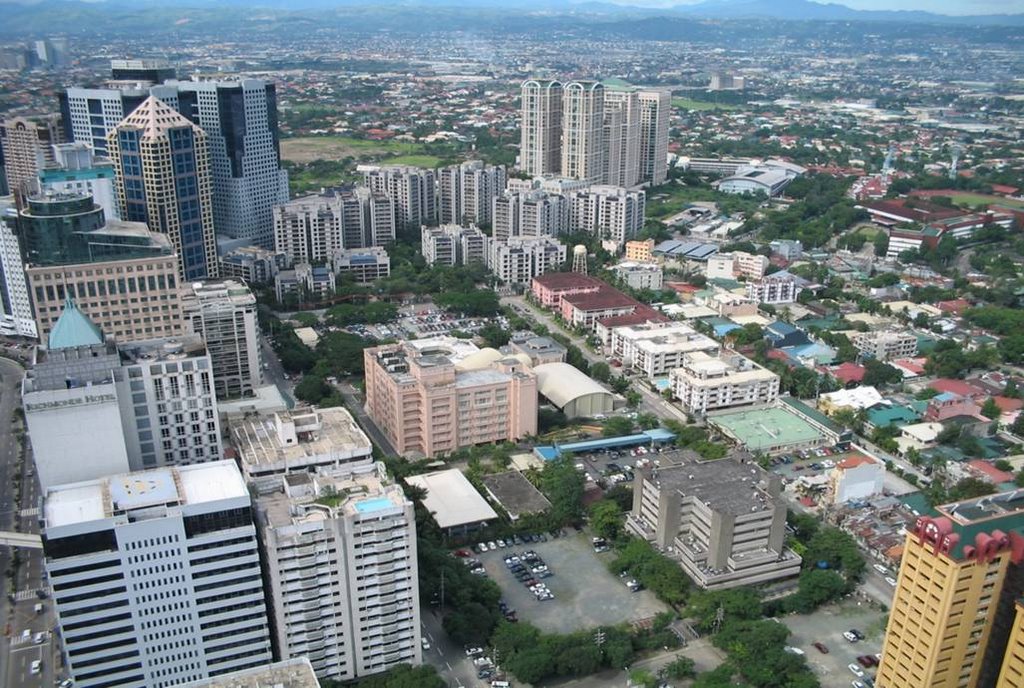 (The Philippine Stock Exchange Center and other commercial and residential
landmarks of Ortigas center, Metro Manila)
Ortigas and Company chief operating officer Rex Drilon said he doesn’t want Ortigas Center (OC) to be the “kitchen of Metro Manila” so his company is pushing for the implementation of a P200 million master plan to redevelop the business district and reaffirm his status as “the business center” of the metropolis. Prepared by Palafox Associates, the master plan—to be implemented by the Ortigas Association that manages OC—aims to transform the Ortigas Center (OC) into a transit-oriented, mixed use, pedestrian friendly business center. Will the master plan take-off?
By just looking at the map, one can sense that Ortigas is a natural winner. It’s practically right at the center of the metropolis. It’s accessible by rail (i.e. the Metro Rail Transit) and Metro Manila’s major transport routes (Edsa Avenue) and it’s surrounded by middle-to-upper class residential subdivisions. Major urban services and amenities for shopping, entertainment, education, and travel are already in place. The center has been chosen by big business organizations (e.g. San Miguel, Robinsons, SM group of companies) the other half of the Philippine Stock Exchange) as well as by international multilateral institutions (e.g. Asian Development Bank, World Bank) as their headquarters. Lately, it has attracted a lot of internationally known call centers and outsourcing companies like Client Logic and Ambergris Solutions.
Not getting the buzz
But why is it that it doesn’t seem to get the buzz as a business center these days? Why is it that people usually think of Makati when talking about the metropolis’ “business or corporate” center?
As an observer, one cannot help but think that all these winning factors may have become OC’s liabilities. It’s so easy to rest on one’s laurels once you have all the major big-name locators like the ADB and San Miguel Corporation. That’s probably the reason why there does not seem to be any new ground-breaking projects in the area last five to seven years. Even Drilon admits to the following problems within the OC:
• No link from the major public transport hubs to the inner core of the CBD. People without cars could easily get there through MRT by disembarking either at Shaw or Ortigas Avenue. Once you get there, however, you have to get a taxi to go around. That makes it very expensive place to go.
• OC is not conducive to walking. A pedestrian, say an employee in one of the offices there trying to saving money, may try to walk but the roads are narrow and uncovered. In just a few minutes, you will be sweating like crazy. During the rainy season, you better bring umbrellas unless you fancy yourself running like crazy towards the nearest shop when the rains fall. It seems like the planners simply saw buildings and cars—no people!—when they designed the OC.
• Traffic congestion, confusing traffic. This is expected because, without pedestrian facilities, even office workers inside OC have to drive a car a few blocks away to preserve their white-collar dignity.
• Confusing signages (not based on international standards), decaying and ugly welcome arches.
• Unplanned developments within properties as well as unfinished and decrepit buildings and unmaintained vacant lots.
• And surprise, surprise!: OC doesn’t have a centralized sewage facilities.
No wonder why land values in Ortigas is less than half that of Makati. These days a prime lot in Makati could easily fetch as high as P120,000 per square meter while the same piece of real estate would only command P75,000 per square meter. Vacancy rate now in the Makati central business district (CBD) is just about 5 percent while in the OC is still in the double digit even though OC has pioneered the hosting of call centers and other outsourcing companies several years ago. Now there are fears that land values in the OC may freeze for long time as call centers are more likely to locate in city centers where they could attract the required labor pool. Call centers and outsourcing companies themselves have about 14 new emerging business centers all over Metro Manila on top of the original five—Makati, Cubao, Binondo, Escolta, and Ortigas—to chose from. There are trends now for call centers to locate operations in malls (e.g. SM in Pasay, Robinsons in Novaliches). Unless, the OC could reinvent itself, it may just lose its luster.
Towards a walkable city
Drilon doesn’t want that to happen that is why his company has initiated the preparation of the master plan. In tangible terms, the masterplan translates to the construction of elevated walkways; covered walkways; improved streetscapes, sidewalks, more greens, better lamp posts; and other components including better traffic management, security and fire-fighting facilities. The entire plan will cost P200 million.
From the MRT station in front of the ADB, the master plan will provide elevated pedestrian walkways on opposite directions towards SM Megamall and Robinsons Galleria Mall. From the malls, pedestrian may chose to access the offices, hotels, residential areas either through covered walkways or through public transport. There will also be 60-foot pylons to serve as entrance markers for those who are entering OC through private vehicles. The business center will also spent P159 million to improve the streetscapes in Julia Vargas, ADB and San Miguel Avenue, Ortigas Junior Avenue, Bank Road and St. Francis Streets.
So we go back to the earlier question—will it work? Conceptually, the plan is excellent. You can’t fault for what is there. You can only criticize it on what is not there.
For instance, a person who loves to drive cars would not see the construction of car parks there. That’s one glaring fact. Nevertheless, that’s probably deliberate given the fact that Palafox Associates is a known advocate of neo-urbanism, a global movement promoting compact, “walkable,” and green cities. Drilon himself doesn’t see the need for one because revenues from a car park on per square meter basis is lower than any other commercial land uses. This writer’s view is that OC could actually do away with it given the fact that it’s accessible through the MRT. The proposed MRT 8, envision to pass through the center of OC, will also provide greater access. So there would be less need for a stand-alone car park especially if the MRT 8 would have its own park-and-ride facility. Besides, an additional car park inside OC will just attract more vehicle traffic thus worsening congestion and defeating the rationale for a calmer, pedestrian- and transit-oriented city. Nevertheless, SM and Robinsons malls might yet have the incentive to expand their own car parks as they are the ones to benefit from increased traffic.
Cash register redevelopment?
The master plan may really be just about raising property values, a pure cash register redevelopment effort. There seems to be no intention of providing museums, public or street art (e.g. sculpture of the best of us Filipinos), monuments, or sports facilities. That means that planners or OC officials simply look at clients (e.g., workers, corporate stakeholders, shoppers, and kibitzers) as plain consumers. Their participation would simply be as worker bees or as buyers. They are not supposed to enjoy and partake of the finer things in life—those intangibles that enable us tower above the primates and other dwellers of the animal kingdom. If one has nothing to buy (e.g., no money to shop, no resources to set up a business) or nothing to sell (e.g. no skilled labor to offer, no product or services to provide), the place is not for you.
You can find a lot of public art pieces and monuments to greatness—these representations of our noble aspirations and intentions, our dreams, our potentials—in most cities of developed countries. Those business centers allow for these public art pieces and monuments because their economic elites feel that, besides making money, they also need to uplift the level of human existence beyond the tangibles and the drudgeries of city life. It’s the phenomenon of economic elites performing their role as social reformer! Not in the OC. But then again, why should OC bother when most business centers old and new don’t have them as well?
Institutional constraints
As is, the master plan is will take off and make lot of difference in the OC provided the institutional factors are there. Institutional factors could actually be its Achilles Heel. There is no doubt the Ortigas family is willing and eager to push with the redevelopment plan. In the last two years, the Ortigas & Company—sans the glare of media—has been undertaking a lot of property development projects. It has refurbished Greenhills and recently has completed Tiendesitas, a 30,000 square meter shopping complex showcasing Philippine products, cuisine, crafts, plants, and other uniquely made Philippine products. (Tiendesitas is part of Ortigas & Company’s the larger 18.5 hectare development project at the corner of the Ortigas Avenue and E. Rodriguez Avenue in Barangay Ugong, Pasig that will host the SM hypermart, a fun ranch for kids, an auto mall, a wellness center, and a technology corridor).
But the Ortigases’ main hurdle would be the fact that they have less power in the Ortigas Center Association that is managing the OC than one could imagine. Rex Drilon says while Ortigas & Company is actively pushing for the speedy implementation of the master plan, they only have one seat in the 15-person board. Unlike Makati, the Ortigases had also turned over ownership and control of the road network within the OC to the government, thus giving them less influence in traffic management and redevelopment of roads in the OC. “You can’t spend private money on a public property, and the government also couldn’t spend public money on private property,” said Drilon.
OCAI is composed about 200 member properties, counting among its members the leading companies like the Philippine Stock Exchange, San Miguel Corporation, SM, and the Robinson Malls that offer more than 750,000 square meters of retail spaces. Yet the OCAI actually has no money to implement the master plan because of it charges only P0.10 per square meter for membership dues. How small is that amount? Consider Makati: members of Masea, a similar organization that runs Makati CBD charges P4.50 per square meter, so they have so much money for maintenance, and continuing development. The group also has not turned over control of the road network to the local government so it can maintain good road quality standard that is not possible if it’s been under public ownership and control.
Where's the money?
So where would the OCAI get the P200 million for the master plan? Drilon hopes that local government units—Quezon City, Mandaluyong, and Pasig—would shoulder most of the cost. It appears that the OCAI is also praying that the Metro Manila Development Authority (MMDA) would also contribute some money. About 65 percent of OC belongs to Pasig, 30 percent Mandaluyong, and 5 percent Quezon City while peripheral roads are under the jurisdiction of MMDA and DPWH. Drilon thinks that it’s just right that LGUs should bear the bulk of the cost because of the huge tax revenues that these LGUs generate from the OC. And rightly so. But the practical question is—how would these LGUs, MMDA, and DPWH share the financial cost? That’s a difficult to answer considering that Quezon City will soon be developing its own business district along Quezon Avenue adjacent to Edsa.
From the “political market” point of view, it would appear that most users of OC are not going to vote in said municipalities. So while OC may generate a lot of cash for LGUs, they don’t provide the votes that would enable local politicians to win elections. The mayors, therefore, may have to tendency to priorities expenditures on vote-rich and poorer communities and less “on the rich” ones like the OC. Of course, the MMDA and the mayors are probably “progress-oriented” and that they are not going to jeopardize the goose the lays the golden eggs. However, putting the burden of financing the master plan on three LGUs and MMDA puts its fate on a political process that usually takes so much time to complete. That’s probably the reason why Drilon expects the entire plan to be completed within 5 years. If one is used to the decision-making process of the private sector, five years might be too long a time frame considering that the pace of change in competing business centers—20 of them all over the metropolis!—are accelerating.
Thursday, January 05, 2006
Hey, we are not sinking in some bottomless pit the way career pessimists would like us to believe!
If you think the country’s manufacturing sector is doing badly, think again. The latest monthly integrated survey of selected industries (MISSI) shows that the average capacity utilization of the manufacturing sector has reached 80.4 percent in October, the highest in the last four years. This could simply mean that factories are a little bit busier in the last quarter of the year, contrary to popular perceptions.
Hey, we are not sinking in some bottomless pit, the way career pessimists would like us to believe!
Certainly, this trend has something to do with the Christmas season. If one looks at the details, one could see food manufacturing as among those having the high average capacity utilization. Food manufacturers are among those that enjoyed higher production values, together with other industries including petroleum products, chemical products, electrical machinery, textiles, furniture and fixtures, beverages, rubber products, leather products, and miscellaneous manufactures.
In terms of sales value, food manufacturing also enjoyed double-digit growth rate in October, together with petroleum products, chemicals, basic metals, transport equipment, furniture and fixtures, and leather products.
However, it appears to be that the latest statistics is also part of an emerging trend. If one plots that average capacity utilization of industries over time, it would show that the figure has actually been creeping up since the last seven months. The major driver of this trend is the improving performances of food manufacturing, beverage, textiles, rubber products, chemical products, petroleum products, basic metals, electrical machinery, and miscellaneous manufactures. It appears to be a pretty broad-based trend so far.
In the last few months, there seems to be a perception that the country’s industrial sector has been on the slump particularly after the latest export figure declined by 3.2 percent. The real reason for this decline, however, is the shifting of the one Japanese company of its one-billion-a-year laptop export production facility in China while maintaining its microchip operations here in the country. Considering that electronics account for almost 60 percent of the country’s exports, a one billion-dollar difference would surely make a dent on the export growth figure. But it would appear that other products like control and instrumentation, medical and industrial instrumentation, other electronics, garments, wood manufactures, chemicals, machinery and transport equipment, processed food and beverages, and iron and steel were doing fairly in the export markets.
What drives factory managers to rev up factory activity? One factor could be that since January, manufacturing firms’ sales value has been growing at about 8 percent on average. That figure is not bad considering that inflation hovers only at 7 percent. The producer prices index which measures the average change over time in the selling prices received by factories for their products has been growing at double digit rates since April. Indeed, there seems to be some incentives for some industries to make their factories busy, the reason why the manufacturing sector in general grew by 5.4 percent in the last three quarters of the year.
Whether this level of performance, however, is making a difference is another matter. The October round of the Labor Force Survey indicates that the industry sector contributed only about 6,000 incremental jobs. In fact, the “wage and salary” component of the industry sector actually lost 36,000 jobs. What made up for the losses are “own account” industry workers—probably struggling entrepreneurs in small-scale mining and construction. Our own guess is that we would only see the manufacturing sector taking in lots of new workers once the average capacity utilization starts approaching 85 percent average. Sadly, that’s a long way to go.
Hey, we are not sinking in some bottomless pit, the way career pessimists would like us to believe!
Certainly, this trend has something to do with the Christmas season. If one looks at the details, one could see food manufacturing as among those having the high average capacity utilization. Food manufacturers are among those that enjoyed higher production values, together with other industries including petroleum products, chemical products, electrical machinery, textiles, furniture and fixtures, beverages, rubber products, leather products, and miscellaneous manufactures.
In terms of sales value, food manufacturing also enjoyed double-digit growth rate in October, together with petroleum products, chemicals, basic metals, transport equipment, furniture and fixtures, and leather products.
However, it appears to be that the latest statistics is also part of an emerging trend. If one plots that average capacity utilization of industries over time, it would show that the figure has actually been creeping up since the last seven months. The major driver of this trend is the improving performances of food manufacturing, beverage, textiles, rubber products, chemical products, petroleum products, basic metals, electrical machinery, and miscellaneous manufactures. It appears to be a pretty broad-based trend so far.
In the last few months, there seems to be a perception that the country’s industrial sector has been on the slump particularly after the latest export figure declined by 3.2 percent. The real reason for this decline, however, is the shifting of the one Japanese company of its one-billion-a-year laptop export production facility in China while maintaining its microchip operations here in the country. Considering that electronics account for almost 60 percent of the country’s exports, a one billion-dollar difference would surely make a dent on the export growth figure. But it would appear that other products like control and instrumentation, medical and industrial instrumentation, other electronics, garments, wood manufactures, chemicals, machinery and transport equipment, processed food and beverages, and iron and steel were doing fairly in the export markets.
What drives factory managers to rev up factory activity? One factor could be that since January, manufacturing firms’ sales value has been growing at about 8 percent on average. That figure is not bad considering that inflation hovers only at 7 percent. The producer prices index which measures the average change over time in the selling prices received by factories for their products has been growing at double digit rates since April. Indeed, there seems to be some incentives for some industries to make their factories busy, the reason why the manufacturing sector in general grew by 5.4 percent in the last three quarters of the year.
Whether this level of performance, however, is making a difference is another matter. The October round of the Labor Force Survey indicates that the industry sector contributed only about 6,000 incremental jobs. In fact, the “wage and salary” component of the industry sector actually lost 36,000 jobs. What made up for the losses are “own account” industry workers—probably struggling entrepreneurs in small-scale mining and construction. Our own guess is that we would only see the manufacturing sector taking in lots of new workers once the average capacity utilization starts approaching 85 percent average. Sadly, that’s a long way to go.
Wednesday, January 04, 2006
Heritage Foundation’s Errors in the "2006 Index of Economic Freedom"
I like the idea of economic freedom and its correlation with economic growth and progress. I completely agree with Heritage Foundation on that point. Nevertheless, I’ve noticed several gross inaccuracies in its report on the Philippines that need to be corrected to ensure the credibility of the “Index of Economic Freedom” Report. Let me discuss each one of them:
1. On Page (319) the second paragraph says that “In 2004, tsunami aid graft was but one sign of rampant corruption, along with human trafficking and a ballooning black market.” [Italics supplied] The Heritage Foundation must be referring to another country in South Asia. The Philippines was never hit by the tsunami in 2004. The last time a tsunami created havoc in the Philippines was in 16 August 1976, killing more than 3,000 people (some say its 8,000). That incident was caused by the faulting of the Earth’s crust in the Moro Gulf in Southern Philippines. About “human trafficking and ballooning black market,” this statement is also an overstatement because these are probably not rampant as what Heritage Foundation would like to suggest. In fact, these are not real issues here.
2. Paragraph number 8 (Page 319) says that “Arroyo has increased government spending, which combined with lagging tax revenues, has led to massive deficits.” [Italics supplied].Yes, there is “massive deficit” and but government spending has not been rising in real terms under the Arroyo Administration in an effort to bring down the Philippines’ deficit to GDP ratio and, hopefully, get a better sovereign ratings. The fiscal deficit has largely been due to the worsening tax effort and the reduction of import tariffs under the country’s trade liberalization program that accelerated since 1995 when the government joined the World Trade Organization.
3. Paragraph Number 9 says: “The government is slow in promoting privatization, as the state still owns a majority of Filipino corporations.” [Italics supplied] This is grossly inaccurate. That scenario was true only during the Marcos dictatorship more than 2o years where a lot of Filipino companies were either owned by Marcos and his cronies or by state that are also managed or controlled by Marcos and his cronies. Since the Edsa Revolution of 1986, most of these government-owned and controlled corporations, several hundreds of them, were privatized. Right now, the only few government-owned or control corporations are the National Power Corporations (Napocor), the National Food Authority, and the Channels 4 and 9 (TV stations). Napocor’s assets themselves are being privatized. These are substantial assets under government control but nowhere do they represent “owning a majority of Filipino corporations” as claimed by the Report.
4. Paragraph Number 10 says: “The chief obstacles to stable growth remain high tax rates, poor infrastructure, extensive government ownership of business, low foreign investment, and entrenched government corruption.” [Italics supplied] Again, this is inaccurate for reasons cited above and inconsistent with the score (2, “mostly free”) that Heritage Foundation gave on “government intervention in the economy.” If Heritage thinks there is “extensive government ownership of business” in the Philippines, why should it gave a high score of 2 or “mostly free”?
5. On “trade policy,” the report said that “licensing, quotas, and safeguard measures are widespread.” Again, another inaccuracy. Licensing and quotas has long been gone in the Philippines—January 1995 when the World Trade Organization came into force. “Special safeguards,” yes but they are used sparingly for fear that the Philippines, a poor country, could get into legal troubles in the dispute settlement mechanism of the WTO.
6. On Page 320, on “Wages and Prices,” the report, quoting the Intelligence Unit says: “Price ceilings are usually imposed only on basic commodities (such as rice, milk, sugar, pork, chicken, cooking oil, and flour) in areas … under a state of calamity or emergency, such as those devastated by typhoons.” Again, this is a gross inaccuracy! Since the fall of the Marcos dictatorship, the Philippines has never imposed price controls or price ceilings on any commodity. And if it would, the government can never effectively implement it anyway. If I were to give a score on this one, I would give the Philippines 2 (“mostly free”).
Overall, my own take is that the Philippines’ deserves a higher “economic freedom index” than what Heritage Foundation has given. Maybe the Philippines belongs somewhere in between 2.5-2.99 (“mostly free”). I suggest that the Foundation should stop using secondary reports. Maybe the best thing that Heritage Foundation could do is come here in the Philippines and conduct their own research. Or maybe, the Foundaton should commission local academic researchers or institutions to prepare the draft on the Philippines for them.
1. On Page (319) the second paragraph says that “In 2004, tsunami aid graft was but one sign of rampant corruption, along with human trafficking and a ballooning black market.” [Italics supplied] The Heritage Foundation must be referring to another country in South Asia. The Philippines was never hit by the tsunami in 2004. The last time a tsunami created havoc in the Philippines was in 16 August 1976, killing more than 3,000 people (some say its 8,000). That incident was caused by the faulting of the Earth’s crust in the Moro Gulf in Southern Philippines. About “human trafficking and ballooning black market,” this statement is also an overstatement because these are probably not rampant as what Heritage Foundation would like to suggest. In fact, these are not real issues here.
2. Paragraph number 8 (Page 319) says that “Arroyo has increased government spending, which combined with lagging tax revenues, has led to massive deficits.” [Italics supplied].Yes, there is “massive deficit” and but government spending has not been rising in real terms under the Arroyo Administration in an effort to bring down the Philippines’ deficit to GDP ratio and, hopefully, get a better sovereign ratings. The fiscal deficit has largely been due to the worsening tax effort and the reduction of import tariffs under the country’s trade liberalization program that accelerated since 1995 when the government joined the World Trade Organization.
3. Paragraph Number 9 says: “The government is slow in promoting privatization, as the state still owns a majority of Filipino corporations.” [Italics supplied] This is grossly inaccurate. That scenario was true only during the Marcos dictatorship more than 2o years where a lot of Filipino companies were either owned by Marcos and his cronies or by state that are also managed or controlled by Marcos and his cronies. Since the Edsa Revolution of 1986, most of these government-owned and controlled corporations, several hundreds of them, were privatized. Right now, the only few government-owned or control corporations are the National Power Corporations (Napocor), the National Food Authority, and the Channels 4 and 9 (TV stations). Napocor’s assets themselves are being privatized. These are substantial assets under government control but nowhere do they represent “owning a majority of Filipino corporations” as claimed by the Report.
4. Paragraph Number 10 says: “The chief obstacles to stable growth remain high tax rates, poor infrastructure, extensive government ownership of business, low foreign investment, and entrenched government corruption.” [Italics supplied] Again, this is inaccurate for reasons cited above and inconsistent with the score (2, “mostly free”) that Heritage Foundation gave on “government intervention in the economy.” If Heritage thinks there is “extensive government ownership of business” in the Philippines, why should it gave a high score of 2 or “mostly free”?
5. On “trade policy,” the report said that “licensing, quotas, and safeguard measures are widespread.” Again, another inaccuracy. Licensing and quotas has long been gone in the Philippines—January 1995 when the World Trade Organization came into force. “Special safeguards,” yes but they are used sparingly for fear that the Philippines, a poor country, could get into legal troubles in the dispute settlement mechanism of the WTO.
6. On Page 320, on “Wages and Prices,” the report, quoting the Intelligence Unit says: “Price ceilings are usually imposed only on basic commodities (such as rice, milk, sugar, pork, chicken, cooking oil, and flour) in areas … under a state of calamity or emergency, such as those devastated by typhoons.” Again, this is a gross inaccuracy! Since the fall of the Marcos dictatorship, the Philippines has never imposed price controls or price ceilings on any commodity. And if it would, the government can never effectively implement it anyway. If I were to give a score on this one, I would give the Philippines 2 (“mostly free”).
Overall, my own take is that the Philippines’ deserves a higher “economic freedom index” than what Heritage Foundation has given. Maybe the Philippines belongs somewhere in between 2.5-2.99 (“mostly free”). I suggest that the Foundation should stop using secondary reports. Maybe the best thing that Heritage Foundation could do is come here in the Philippines and conduct their own research. Or maybe, the Foundaton should commission local academic researchers or institutions to prepare the draft on the Philippines for them.
Tuesday, January 03, 2006
Evolution versus Intelligent Design: An Unintelligent Debate
Doesn't this debate about evolution versus intelligent design bother you? In the Philippines, the issue does not get much attention the way that it generates controversy in the United States. An email (January 4) from Judith Kliks, a friend from USA, seems to capture this raging culture war in her country.
Dear David, Your son is quite a man already. As a believer in science, he would be dismayed at the debate across the US on the subject of teaching evolution instead of creationism and intelligent design. The latter two theories are being promoted by Christian fundamentalists, and at the very least, they want their theories taught along side evolution. Several cases are now in the court system concerning this controversy. Sadly, the current administration seems to bow to the wishes of Christian fundamentalists, as they form an important base of support for the Republicans. Fundamentalists, be they Christian, Muslim, Hindu, Jewish, etc., are so intolerant, and epitomize much of what is wrong with the world right now. We can only hope that more open minds prevail in 2006. With regards, Judith
My own religious background is Southern Baptist, probably one of those "fundamentalist" Christian groups in the US and the Philippines. But I never close my mind to the issues regarding creation vs evolution. My position is this: let creation be taught in Church Sunday schools and evolution in schools. For me creationism is a matter of faith and evolution of scientific process and at this stage there is really no urgency to "reconcile" the two. Who knows they are probably one and the same--- creationism answering the "why" and evolution the "how" of everything in the Universe (according to one wise-guy)? For all we know, man's and God's time are different. What if God reckons time in terms of "geologic time"? Let the quest to understand the Higher Being through theology and philosophy continue while science pursues its own course. Who knows these two quests might yet yield us the truth and set us all free from ignorance?
Dear David, Your son is quite a man already. As a believer in science, he would be dismayed at the debate across the US on the subject of teaching evolution instead of creationism and intelligent design. The latter two theories are being promoted by Christian fundamentalists, and at the very least, they want their theories taught along side evolution. Several cases are now in the court system concerning this controversy. Sadly, the current administration seems to bow to the wishes of Christian fundamentalists, as they form an important base of support for the Republicans. Fundamentalists, be they Christian, Muslim, Hindu, Jewish, etc., are so intolerant, and epitomize much of what is wrong with the world right now. We can only hope that more open minds prevail in 2006. With regards, Judith
My own religious background is Southern Baptist, probably one of those "fundamentalist" Christian groups in the US and the Philippines. But I never close my mind to the issues regarding creation vs evolution. My position is this: let creation be taught in Church Sunday schools and evolution in schools. For me creationism is a matter of faith and evolution of scientific process and at this stage there is really no urgency to "reconcile" the two. Who knows they are probably one and the same--- creationism answering the "why" and evolution the "how" of everything in the Universe (according to one wise-guy)? For all we know, man's and God's time are different. What if God reckons time in terms of "geologic time"? Let the quest to understand the Higher Being through theology and philosophy continue while science pursues its own course. Who knows these two quests might yet yield us the truth and set us all free from ignorance?
Crime? What crime?
Becoming a crime victim is a scary thought but that is not preoccupation of Filipinos these says as only 15 percent say they were victimized in the last six months. At the national level, Filipinos are rather worried about inflation, graft and corruption, economic recovering and attaining peace than criminality.
These are among the results of the latest “crime victimization” study conducted by the Pulse Asia, a private polling organization based in Quezon City.
“At the personal level, Filipinos are most concerned about finishing their education or providing schooling for their children (40%), having a good job (45%), and staying healthy (50%)” said Dr. Ana Maria Tabunda, the executive director of the Pulse Asia. Only 21 percent are concerned about becoming a crime victim.
I thought all along the Philippines is one of the most crime-prone places on earth. The survey seems to say otherwise. Or is it? 15 percent means 15 out of a hundred. That's quite high. But that also means that 85 percent were not victimized. Which is also high. I don’t have statistics on crime victimization rate beyond the borders but it's fine with me when most of us are not spooked by it. What do you think?
These are among the results of the latest “crime victimization” study conducted by the Pulse Asia, a private polling organization based in Quezon City.
“At the personal level, Filipinos are most concerned about finishing their education or providing schooling for their children (40%), having a good job (45%), and staying healthy (50%)” said Dr. Ana Maria Tabunda, the executive director of the Pulse Asia. Only 21 percent are concerned about becoming a crime victim.
I thought all along the Philippines is one of the most crime-prone places on earth. The survey seems to say otherwise. Or is it? 15 percent means 15 out of a hundred. That's quite high. But that also means that 85 percent were not victimized. Which is also high. I don’t have statistics on crime victimization rate beyond the borders but it's fine with me when most of us are not spooked by it. What do you think?
Monday, January 02, 2006
Ortigas Center: Towards a Transit-Oriented City?
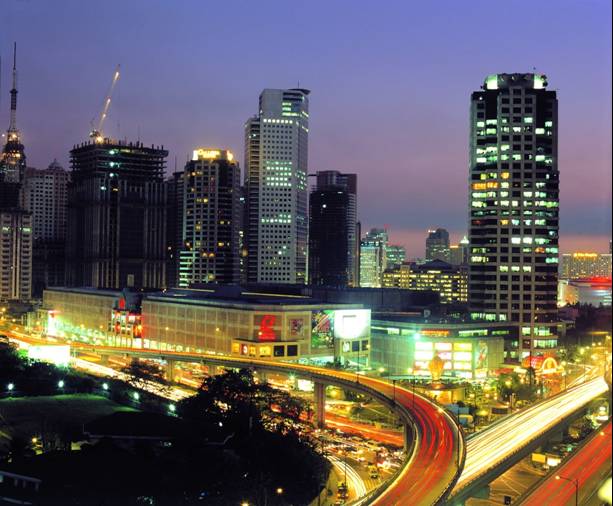
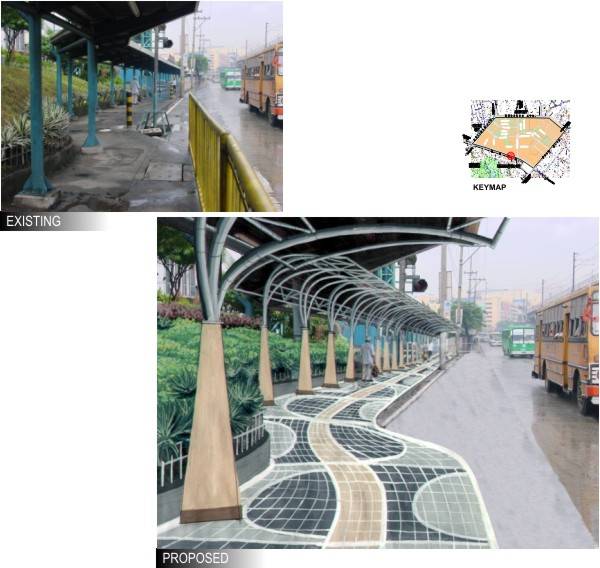 (Picture 1 shows Ortigas Center at night while Picture 2 shows the proposed covered walk along Edsa Avenue under the new 200 million-peso redevelopment plan. All pictures provided by Ortigas & Company).
The Ortigas & Company announced last week that the company is pursuing a P200 million redevelopment program of the 100-hectare Ortigas Center to raise property values and upgrade its status as a “premiere” business district of Metro Manila at par with Makati.
In an interview with media representatives, Rex Drilon, chief operating officer of the Ortigas and Company, said they had hired the services of the Palafox and Associates to prepare a master plan to transform Ortigas Center into “transport-oriented, pedestrian-friendly, mixed-use” business center.
The plan, Drilon said translates to the construction of elevated walkways; appropriate signages based on international standards; improved streetscapes with wider sidewalks, street greens, railings, and better lamp posts; and covered ground-level walkways. Mimicking Los Angeles, the plan would also involve the construction of five 60-foot pylons to serve as markers for the five major entrances to the Ortigas Center.
The elevated walkway is intended to facilitate mobility of people, particularly pedestrians, from the public transport systems like the Metro Rail Transit, buses and jeepneys stops towards the major shopping centers, hotels, schools, and offices within the business district.
According to Drilon, Bayani Fernando, the chair of the Metropolitan Manila Development Authority and the local governments of Pasig City, Mandaluyong, and Quezon City have already approved the master plan “in principle.” Nevertheless, Drilon expects all the projects to be completed within five years.
Drilon admitted that the master plan is his company’s strategy for Ortigas Center to catch up with Makati central business district and other emerging business centers in the metropolis.
“Ortigas Center has lagged behind Makati in terms of desirability as a business district [as manifested by] lower land values, lower rental rates, and lower occupancy rates,” said Drilon. “Makati has been redeveloping and new business business districts are threatening to overtake Ortigas Center—Filinvest Corporate City, Madrigal Business Park, Rockwell, Eastwood City, Araneta Center, among others.”
Drilon said land values in Ortigas is only about P75,000 per square meter while a prime land in Makati would now costs as high as P120,000 per square meter.
In an earlier interview with Claro Cordero, property analyst of the Leechiu and Associates, vacancy rate in Makati is just 5 percent as against Ortigas 10 percent or higher.
Part of the original 4,000 “Mandaloyon estate” that were obtained by the Ortigas family from the friars, the Ortigas Center was envisioned as a “first class commercial and business complex.” The center currently houses big local and international institutions including the Philippine Stock Exchange, San Miguel Corporation, Shoemart, Robinsons Malls, World Bank and the Asian Development Bank. A lot of call centers companies have set-up operations in the area due to its central location.
The redevelopment of Ortigas Center, Drilon said, has recently become more urgent as lot owners have started to complain about traffic congestion, ugly and unfinished structures, dug-up or bad roads, and “pedestrian unfriendliness.”
Costing P200 million, the redevelopment program would be broken down as follows: elevated walkway (P27.4 million), pylons at entrances (P3.4 million), streetscape (P31.54 million), waiting sheds (P7.76 million), lamp posts (P114.46 million), signages and others (P1.5 million). Drilon said the total amount amount is actually PP186 million but they are reserving P14 million for other costs.
Drilon said that his company and the Ortigas Center Association are currently discussing how the P200 million project cost would be shared but they are hoping that LGUs will shoulder most of the costs. And while this process is on-going, Ortigas and Company, Drilon stressed, has allocated about P27 million from its own funds to jumpstart the construction of the five pylons at five several sites, namely the ADB Avenue-Ortigas Avenue extension, Ortigas Jr. Avenue-Ortigas Avene Intersection, Doña Juliana Vargas-Meralco Intersection, San Miguel Avenue-Shaw Boulevard Intersection, and the St. Francis Street-Shaw Boulevard Intersection.
(I owe this post to Rex Drilon, chief operating officer of Ortigas & Company. A few weeks ago, I posted a blog criticizing Ortigas Center as a “cruel city” for its lack of facilities for pedestrians. Two days after, Mr. Drilon invited me to a pre-New Year briefing re Ortigas Center’s newly approved “master plan” designed to address complaints about traffic congestion, and pedestrian-unfriendliness. The story above is the result of that briefing.)
Sunday, January 01, 2006
Let There be Everything!: A New Year's Wish From Belarus


The first time I saw MARYNA RAKHLEI (picture above) from Belarus during the first day of the Visitors Program in Washington DC (September 14, 2005), I knew she could be a very interesting person. And she was. With her, never would there be a dull moment. Ask here about anything and she would always have strong, sharp opinions. Last week, I asked here how she would spend the holidays and she responded in her usual frank, witty self.
We celebrate Christmas based on the old calendar, two weeks later, on January 6. But you probably do it as well. The all-night-service at the church is very special. But after 70 years of communism, it's not that common. Like me, I'm not going to celebrate.
New Year is a family holiday that Soviets substituted Christmas with. We come together and eat and drink and watch TV. Usually people stay home - with friends or family members and have parties.
I have no more wishes. My colleagues are crazy enough to wish each other warm prison cells and good lawyers. But it's all not that funny. I wish everyone a lot of energy and creativity and never to be bored. LET THERE BE EVERYTHING!
Snow, snow is fantastic. Though it's snow, though it's white, it's absolutely warm. Snow whitewashes the differences, the faults and drawbacks. It counterbalances and soothes. It has no sound and makes sound disappear. When it snows the world is all-white - the sky, the trees, the ground, yourself - everything. I probably told you I think it's fairytale-like when you see nothing but the white world that you never saw before – new clean, fantasy-like, sparkling, different. You can never be bored with it.
A Meaningful New Year
I’m proud to tell the world I had the best New Year in my whole life. No, I did not binge, get drunk, or shoot fireworks. We simply had fried chicken, cheese, rice, and fruits. No wine. No alcoholic drinks, just a liter of Coke Light. But I had the best time of my life. Why?
As the bursts of fireworks rose to a crescendo, I entered my son’s room wondering what sort of things we Filipinos have missed as we were scrambling for the New Year. “It’s the December 30 death anniversary of our national hero, Jose Rizal,” said Ovid. “We glossed over the relevance of his death, the message he wanted to share to future generations.”
“And what do you think was the message our national hero was trying to deliver?,” I asked.
“I don’t know,” he said. “Maybe the message is coded in Padre Florentino’s words as he dumped Simoun The Jeweler’s treasures into the void of the ocean after the original terrorist-revolutionary in Philippine history breathed his last.”
In Rizal’s second novel El Filibusterismo (The Subversion), Simoun was the sinister manipulator, a Darth Vader of sort, who returned to the Philippines after accumulating so much wealth abroad. He used his money to foment more oppressive measures, more strong-handed policies, more greed and corruption among the ruling elite—the friars, the Spanish bureaucracy, and the civil guards—hoping that the Indios, the masses, would rise up in arms against the Spaniards. That way, he would also get his revenge for a loved one lost. The masses remained servile so he planted bombs under a building where the ruling elites were scheduled to meet. For some human foibles, the plot did not succeed. Wounded in a skirmish with the Guardia Civil and expecting capture, he drank poison and went to Padre Florentino for his last confession.
After he died, the priest threw all the treasures into the bottom of the sea saying: “May Nature guard you in her deep abysses among the corals and pearls of her eternal seas. When for a holy and sublime end men should need you, God will draw you from the breast of the waves… Meanwhile there you will do no evil, you will not distort right, you will not foment avarice.”
What’s the meaning of this passage? What’s that “holy and sublime end” that we need to have for us to recover that great wealth thrown into of the bowels of the ocean? What do those treasures signify? Is it progress? Economic development? Power? Missed opportunities?
The clue—the Kid said—is in the priest’s rebuke of the dying Simoun on his prescription for violence. For the priest, sacrifice, hard work, suffering, and enlightenment are the real paths.
Said Padre Florentino in El Filibusterismo: “The school of suffering tempers; the arena of combat strengthens the soul. I do not mean to say that our freedom is to be won by the blade of the sword; the sword enters very little now in modern destinies, yes, but we must win it, deserving it, raising the intelligence and the dignity of the individual, loving the just, the good, the great, even dying for it, and when as a people reach that height, God provides the weapon, and the idols will fall, the tyrants fall like a house of cards and liberty shines with the first dawn.”
My son was insistent that for Rizal the search for “intelligence and the dignity of the individual” also meant the pursuit of science. It has nothing to do with deliverance through messianic figures or political leaders with “political will.” He pointed Basilio’s rebuttal of Simoun near the grave of her mother who was driven to madness and death by the Friars/Spaniards: “Science is more eternal, more humane, more universal. Within a few centuries, when humanity shall have been redeemed and enlightened; when there shall no longer be races; when all peoples shall have become free; when there are no longer tyrants nor slaves, colonies nor empires; when justice reigns and man becomes a citizen of the world, only the cult of Science will remain; the world patriotism will sound as fanaticism, and whosoever will take pride in patriotic virtues will surely be locked up as a dangerous maniac, as a disturber of the social harmony.”
We spent hours interpreting the meaning of Rizal’s words, debating their relevance in modern times. We did so for hours until we were so tired we needed to sleep. By eight in the morning, I woke up refreshed ready for the new day.
As the bursts of fireworks rose to a crescendo, I entered my son’s room wondering what sort of things we Filipinos have missed as we were scrambling for the New Year. “It’s the December 30 death anniversary of our national hero, Jose Rizal,” said Ovid. “We glossed over the relevance of his death, the message he wanted to share to future generations.”
“And what do you think was the message our national hero was trying to deliver?,” I asked.
“I don’t know,” he said. “Maybe the message is coded in Padre Florentino’s words as he dumped Simoun The Jeweler’s treasures into the void of the ocean after the original terrorist-revolutionary in Philippine history breathed his last.”
In Rizal’s second novel El Filibusterismo (The Subversion), Simoun was the sinister manipulator, a Darth Vader of sort, who returned to the Philippines after accumulating so much wealth abroad. He used his money to foment more oppressive measures, more strong-handed policies, more greed and corruption among the ruling elite—the friars, the Spanish bureaucracy, and the civil guards—hoping that the Indios, the masses, would rise up in arms against the Spaniards. That way, he would also get his revenge for a loved one lost. The masses remained servile so he planted bombs under a building where the ruling elites were scheduled to meet. For some human foibles, the plot did not succeed. Wounded in a skirmish with the Guardia Civil and expecting capture, he drank poison and went to Padre Florentino for his last confession.
After he died, the priest threw all the treasures into the bottom of the sea saying: “May Nature guard you in her deep abysses among the corals and pearls of her eternal seas. When for a holy and sublime end men should need you, God will draw you from the breast of the waves… Meanwhile there you will do no evil, you will not distort right, you will not foment avarice.”
What’s the meaning of this passage? What’s that “holy and sublime end” that we need to have for us to recover that great wealth thrown into of the bowels of the ocean? What do those treasures signify? Is it progress? Economic development? Power? Missed opportunities?
The clue—the Kid said—is in the priest’s rebuke of the dying Simoun on his prescription for violence. For the priest, sacrifice, hard work, suffering, and enlightenment are the real paths.
Said Padre Florentino in El Filibusterismo: “The school of suffering tempers; the arena of combat strengthens the soul. I do not mean to say that our freedom is to be won by the blade of the sword; the sword enters very little now in modern destinies, yes, but we must win it, deserving it, raising the intelligence and the dignity of the individual, loving the just, the good, the great, even dying for it, and when as a people reach that height, God provides the weapon, and the idols will fall, the tyrants fall like a house of cards and liberty shines with the first dawn.”
My son was insistent that for Rizal the search for “intelligence and the dignity of the individual” also meant the pursuit of science. It has nothing to do with deliverance through messianic figures or political leaders with “political will.” He pointed Basilio’s rebuttal of Simoun near the grave of her mother who was driven to madness and death by the Friars/Spaniards: “Science is more eternal, more humane, more universal. Within a few centuries, when humanity shall have been redeemed and enlightened; when there shall no longer be races; when all peoples shall have become free; when there are no longer tyrants nor slaves, colonies nor empires; when justice reigns and man becomes a citizen of the world, only the cult of Science will remain; the world patriotism will sound as fanaticism, and whosoever will take pride in patriotic virtues will surely be locked up as a dangerous maniac, as a disturber of the social harmony.”
We spent hours interpreting the meaning of Rizal’s words, debating their relevance in modern times. We did so for hours until we were so tired we needed to sleep. By eight in the morning, I woke up refreshed ready for the new day.
Subscribe to:
Posts (Atom)